Get Full Government Meeting Transcripts, Videos, & Alerts Forever!
Get email alerts on the Obscenity And Library Materials topic
No spam. Unsubscribe anytime.
Committee hears hours of testimony on obscenity amendments; public comment closed on House Bill 194
Summary
The Judiciary Committee heard extensive, often emotional testimony on House Bill 194, a proposal to expand the state's obscenity law to define material "harmful to minors" and require school and county libraries to restrict minors' access to such material unless a parent opts in.
The Judiciary Committee held an extended public hearing on House Bill 194, a proposal that would amend state obscenity statutes to define material "harmful to minors," remove certain current exemptions for schools and libraries, and require libraries and school districts to restrict minors' access to materials found to be harmful.
Sponsor Representative Rachel Lucas (presenting HB194) said parents and grandparents had discovered books in public schools and libraries that they considered "inappropriate" and said the bill would clarify what is harmful to minors and require parental opt-in for minors to access identified materials. "Parents should be the only people who get to make those decisions for their children," Lucas said during her presentation.
The hearing drew extensive testimony from both sides. The Wyoming Library Association, represented by President Lindsay Travis, urged a "no" vote, saying the bill removes an important exemption for librarians and would circumvent local policy and local governing boards that currently oversee library collections. "Policies already allow local boards to move or remove items," Travis testified, adding that the bill "circumvents local control" and risks removing constitutionally protected materials used for health and sex-education.
College and university representatives and the Community College Commission flagged operational concerns for higher-education libraries and concurrent-enrollment students. Community College Commission Executive Director Ben Moritz asked the committee not to delete the current academic exemption and noted that concurrent-enrolled minors normally require parental consent to enroll.
Educators and the Wyoming Education Association also warned of unintended consequences for classroom instruction and health education. Grady Hutcherson, executive director of the Wyoming Education Association and a 24-year educator, said teachers could be placed at risk of criminal penalties for classroom activities tied to state education standards.
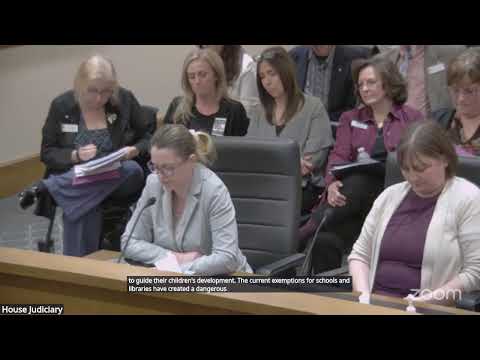
Supporters who urged action described instances where parents said school staff or libraries provided minors with material they considered harmful. Patricia McCoy, a parent, recounted a personal case she described as traumatic and urged the committee to close what she called a "dangerous loophole." "The current exemptions for schools and libraries have created a dangerous loophole that allows some staff to expose minors to inappropriate material while shutting parents out completely," McCoy testified.
The committee heard detailed questions from members about practical implementation: whether the bill would criminalize student-created material (e.g., yearbook content), how recorded communications between minors would be treated, and how museums or college libraries would be covered. Representative Lucas indicated she would consider amendments to preserve parental consent for colleges or other narrowly defined exemptions.
Multiple local library directors and board members described the practical difficulty of segregating materials in small libraries or in digital consortiums. Several public librarians and library-board members described existing reconsideration processes that allow local boards to review challenged materials and urged the Legislature to preserve local governance.
Public comment closed at the end of the hearing; the committee did not vote on HB194 and said it would take the bill up for committee action at a later date. Committee leadership asked those who had not testified to submit written testimony for the record.
What was proposed
Representative Lucas proposed a rewritten obstruction/obscenity provision that, among other things, would do the following: define "disseminate" and "material" broadly; add a new offense for "promoting obscenity to a minor" when a person knowingly provides, promotes or transmits material harmful to minors; and require school and county libraries to move challenged materials from minor-focused collections to adult collections unless parental permission is provided.
Points of contention
- Scope and definitions: Critics said the sponsor's amendments broadened the statutory language in ways that could sweep in materials used in health, history or art instruction. Several speakers asked that "nudity" and other terms be narrowly defined to preserve legitimate educational use. - Local control: Public libraries and school boards said the bill would usurp local policy processes and expose librarians and teachers to criminal liability for collection-development decisions made under locally approved policies. - Higher-education and dual-enrollment: Community colleges and university representatives asked to retain explicit academic exemptions and noted the logistical challenges of separating adult-oriented materials in college libraries.
Next steps
The committee closed public testimony and will consider amendments and committee action at a later date. Lawmakers asked for written submissions from those who did not testify and flagged specific issues'including definitions, academic exemptions and parental-consent mechanics'for follow-up.