Get Full Government Meeting Transcripts, Videos, & Alerts Forever!
Get email alerts on the Department Overview topic
No spam. Unsubscribe anytime.
Alaska DNR lays out priorities on forestry, minerals, wildfire readiness and permitting
Summary
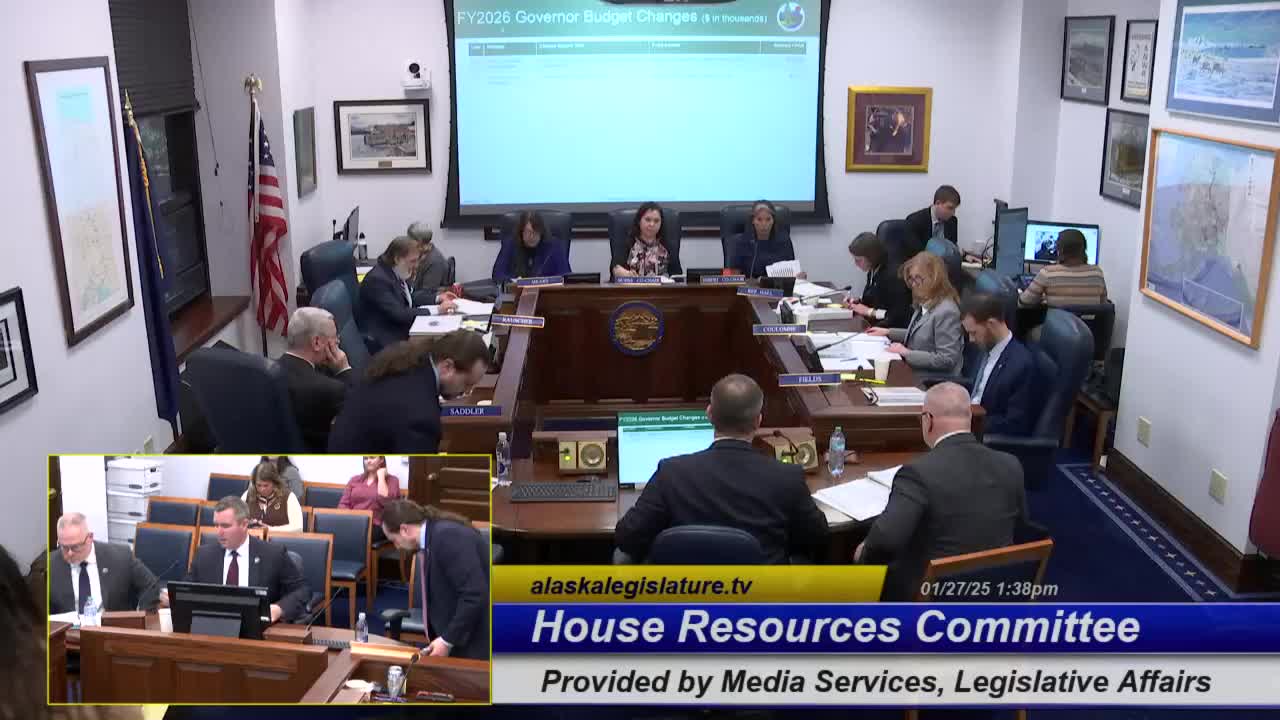
The Alaska Department of Natural Resources outlined a broad set of priorities for 2025 during a Jan. 27 briefing to the House Resources Committee, saying the department will press to expand agricultural production, grow the timber and forest economy, strengthen wildfire prevention and response, accelerate geological mapping of critical minerals, and support accelerating oil and gas activity through permitting coordination and new regulations for carbon capture.
The Alaska Department of Natural Resources outlined a broad set of priorities for 2025 during a Jan. 27 briefing to the House Resources Committee, saying the department will press to expand agricultural production, grow the timber and forest economy, strengthen wildfire prevention and response, accelerate geological mapping of critical minerals, and support accelerating oil and gas activity through permitting coordination and new regulations for carbon capture.
Commissioner John Boyle told committee members the department is pushing to present Alaska to investors and build capacity to manage growing activity across multiple sectors. “Alaska has a compelling message,” Boyle said. “We have 49 of the 50 identified rare and critical minerals.”
Why it matters: The department manages state lands, timber sales, mineral assessments, and wildfire response that underpin jobs, municipal revenues and public safety across Alaska. Several items Boyle and his deputies described—expanded geologic hazard work, permitting capacity for large projects, carbon-capture rules, and investments in forest and agricultural infrastructure—affect state revenues, community resilience and private-sector investment decisions.
Highlights from the briefing
Agriculture - The Division of Agriculture reported an agricultural revolving loan fund and said it manages more than 60 loans. The division said 23 new loans were approved in the last year for roughly $6.1 million and that it administers more than $10 million in federal grants, including microgrants and local food purchase programs. Deputy Commissioner Brett Goodrum highlighted programs to increase land in agricultural production and to improve access to loans and market connections through partnerships such as the Western U.S. Agricultural Trade Association (WUSATA). - The department said the Plant Materials Center recently cleaned about 50,000 pounds of native seed and over 96,000 pounds of cereal grain and maintains disease-free seed potatoes and foundational varieties for growers.
Forestry and wildfire - The Division of Forestry and Fire Protection said it manages roughly 47 million acres of forest on state land, plus about 2.1 million acres of legislatively designated state forests. The division reported selling and harvesting tens of millions of board feet last fiscal year, maintaining more than 100 miles of forest roads, and managing a road network of about 670 miles that provides access for recreation and firefighting. - Timber-related receipts cited in the briefing were modest relative to the industry’s footprint; the division reported timber receipts in the low hundreds of thousands of dollars but said that figure does not capture value returned from road construction, access and local economic activity. Representative Sara Fields asked for a detailed breakout of management costs and revenues; the department said it will provide that figure to the committee. - On wildfire, the department said it manages response across roughly 150 million acres, trains seasonal and emergency firefighters, and has invested in preparedness to reduce reliance on resources imported from the lower 48. The department said it trained 224 firefighters in wildland academies last year, awarded community wildfire defense grants to three applicants for a total of about $310,000, and received roughly $1.02 million in federal funding for training and equipment. The 2024 fire season included 379 fires on just under 700,000 acres, and aircraft logged about 1,400 flight hours and dropped 250,000 gallons of retardant. - Lawmakers asked whether the state can fight fires on federal lands and about coordination with municipalities on evacuation routes and water availability for urban wildland interface areas such as the Anchorage hillside. Boyle said responsibility is shared and described routine joint response through the Alaska Fire Service and other partners; he suggested further follow-up meetings with division staff, including Norm McDonald (deputy division director for Forestry and Fire Protection), to address capacity and local coordination.
Geologic, mineral and hazard science (DGGS) - Deputy Commissioner John Crother reviewed the Division of Geological & Geophysical Surveys (DGGS). He said the division is expanding geologic-hazard capacity—adding staff to improve preparedness and rapid response—and is compiling lidar and other data to help communities understand landslide and flood risk. - DGGS staff assess mineral potential through bedrock mapping, coring and geophysical surveys and continue work with federal partners on programs such as Earth MRI and StateMAP. Crother noted work on carbon sequestration assessments and said licensing under the state’s carbon capture, utilization and storage (CCUS) framework should be available this year after the department finalized implementing regulations. - The Alaska Volcano Observatory (AVO) and DGGS continue to monitor volcanoes statewide; Crother noted Mount Spurr moved one step on the advisory scale last year and emphasized the value of real-time monitoring for communities and aviation.
Oil and gas, permitting and project coordination - Crother reported an upbeat 10-year production forecast and described recent activity in exploration and new pooled units—including Gray Owl, Tulip River, Smith Bay and Narwhal—across the North Slope and offshore areas. The division said it oversaw approximately $180 million in state royalty receipts last year and has been active in royalty audits and data publication intended to encourage exploration. - The Office of Project Management and Permitting (OPMP) coordinates large-project permitting across state agencies, local governments and federal partners. The office manages permitting support for mines and oil-and-gas projects such as Pikka and Willow and also tracks federal regulatory actions that affect Alaska projects. - Crother described two OPMP programs of note: Arctic Strategic Transportation Resources (ASTER), work to assess potential long-term transportation infrastructure on the North Slope, and the state’s carbon-offsets program (sometimes called the “trees bill”), for which the state selected contractor Terra Verde to conduct feasibility work.
Mining, land and water - The Division of Mining, Land and Water manages more than 160 million acres, the department said, and reported $3.79 million in revenue from state land uses (an 8.7% increase over the prior year). The division conveyed more than 700 acres to municipalities, completed land sales and processed water-appropriation permits and certificates. The department said almost 5 million acres of statehood entitlement remain outstanding from the federal government and noted that focused acquisition of that entitlement remains a priority. - Representative Sadler asked about recordable disclaimers of interest and navigability determinations; Boyle said progress depends on federal cooperation and that the state hopes to resume work with the Bureau of Land Management and other federal partners after delays under the prior federal administration.
Parks, trust lands and support services - The Division of Parks and Outdoor Recreation reported record visitation, expanded online reservations and new electronic fee stations; park rangers participated in search-and-rescue missions and law-enforcement support. The Alaska Mental Health Trust Land Office reported it generated more than $17 million in revenue last fiscal year through timber sales, land sales and financing and that those proceeds support trust beneficiaries via services and programs.
Questions and follow-up - Committee members asked for more detail on timber management costs and the net fiscal benefits after infrastructure costs. The department said it will provide a timber-management-cost breakdown to juxtapose costs against receipts and broader value from road access and associated economic activity. - Lawmakers also requested follow-up on geologic-hazard staffing, coordination for wildfire prevention and response in populated areas, and timelines for CCUS licensing and implementation.
Ending - The committee did not take formal votes on the presentation. Cochair Representative Burke closed the hearing with a schedule update and the committee adjourned at 2:59 p.m.