Get Full Government Meeting Transcripts, Videos, & Alerts Forever!
Get email alerts on the Corrections Department Overview topic
No spam. Unsubscribe anytime.
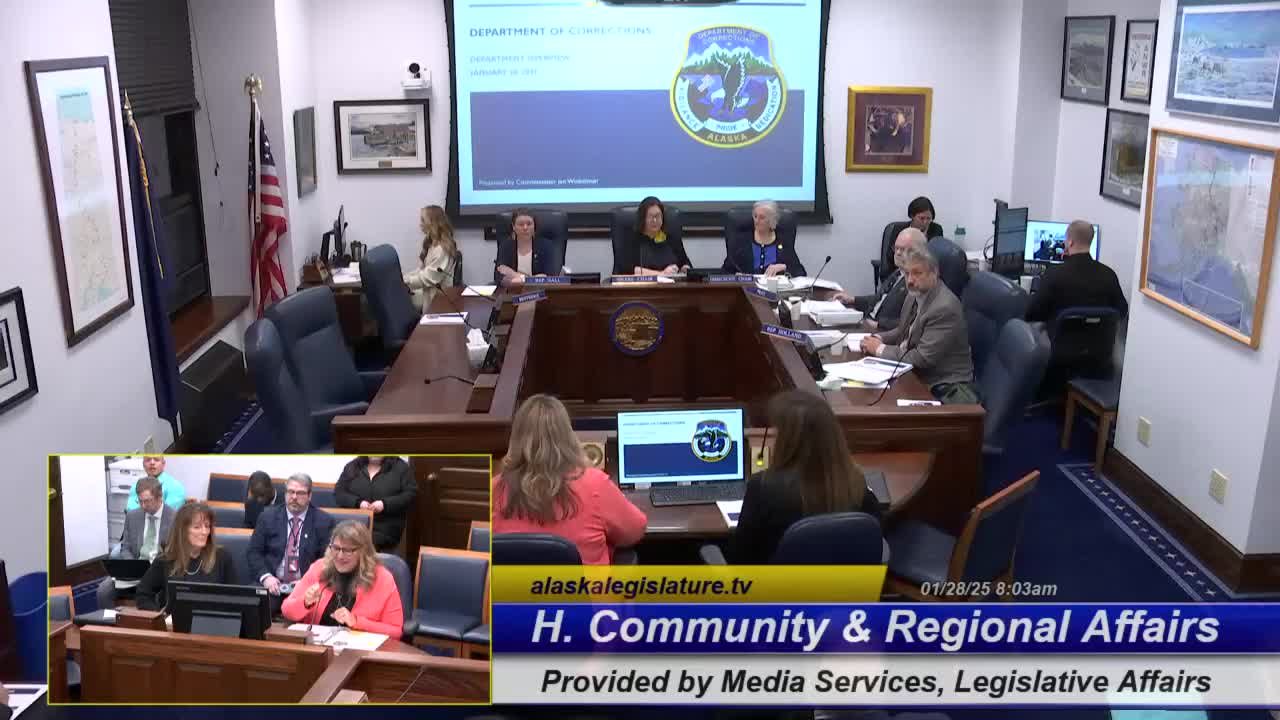
Alaska Corrections Commissioner outlines staffing, suicide-prevention and facility plans at Jan. 28 committee briefing
Summary
Department of Corrections Commissioner Jen Winkelman told the House Community and Regional Affairs Committee the department is working on suicide-prevention measures, vocational programs, tablet pilots and facility repairs while continuing to negotiate community jail contracts and manage staffing and medical-cost challenges.
Commissioner Jen Winkelman told the Alaska House Community and Regional Affairs Committee on Jan. 28 that the Department of Corrections is pursuing suicide-prevention work, expanding vocational programming and piloting inmate and court tablets while managing staffing shortages, rising medical costs and several facility projects.
Winkelman, the commissioner for the Department of Corrections, said the department employs “over 2,100 employees” and described its mission as rooted in the state constitution: “to provide secure confinement, a process of supervised release and reformative programming.” She told the committee the department booked just under 27,000 individuals in the last year and had nearly 10,000 people in its broader custody rolls (including community supervision); at the time of the presentation roughly 4,300 people were held in state facilities.
The presentation summarized recent and ongoing work and explained why members should follow up with budget questions. “Our goal is to become a 0 suicide agency,” Winkelman said, describing Project 2025 work that assessed all 13 state facilities to identify gaps and next steps that will likely generate future budget requests.
Why it matters: Committee members pressed for more data on trends, lengths of stays and the split between unsentenced and sentenced populations; that information drives decisions about facility capacity, programming and capital needs. Co-chair Donna Mears and Co-chair Rebecca Henshoot directed the department to provide follow-up documents and budget detail during upcoming subcommittee work.
Key program and operational items
- Community jails and contracts: The department said it completed revised standards for community jails in response to recent legislative intent language. Deputy Commissioner April Wilkerson said community jails must submit budgets to the Department of Corrections and the department evaluates and allocates funding based on what the legislature appropriates. Wilkerson said communities have six months after the standards were signed to come into full effect, with an effective date of July 1 for full compliance.
- Staffing and recruitment: Winkelman described recruitment and retention as “one of our biggest challenges,” saying corrections positions require applicants who can sustain long periods of hypervigilance. She said staffing levels and vacancies affect the department’s ability to provide services and manage populations.
- Medical and behavioral-health costs: The commissioner said more than half of people entering custody arrive with chronic medical or mental-health conditions, often combined with substance-use disorders, which boosts costs and increases reliance on scarce medical and behavioral-health providers. Winkelman said the department is the largest single mental-health provider in the state, a role she said the department does not prefer but must fill.
- Suicide-prevention work: Project 2025 teams conducted proactive needs assessments across all facilities to identify gaps in suicide-prevention practices. Winkelman said the department will compile a comprehensive report and that some recommendations will be tied to future budget requests.
- Vocational and transitional programming: The department said it has expanded vocational offerings, including a pre-apprenticeship carpentry program launched with the carpenters’ union at Highland Mountain and Wildwood Correctional Center, plus existing trades programs such as welding and ironworkers. Officials said cohorts have completed training and the department aims to expand opportunities aligned to local labor-market needs.
- Tablet pilots and court tablets: Winkelman said the department piloted tablets at Highland Mountain for inmate programming and that the court system has provided separate tablets for virtual court hearings (currently used at Goose Creek and recently enabled at Highland Mountain). She differentiated the court tablets (loaned by the court system for hearings) from department-issued tablets for programming.
- Transportation, K-9 and out-of-state placements: The department reported its transportation unit conducted over 6,800 outside medical transports (629 more than the prior year). Deputy Commissioner Jake Wyckoff described two departmental canine units trained to detect institutional contraband and used for targeted facility searches and occasional support to other law enforcement agencies. Winkelman said out-of-state placements are now rare: seven out-of-state inmates the prior year versus six in the current year; out-of-state housing is used only for safety or high-cost medical reasons.
- Facility capacity and Lemon Creek renovation: Winkelman said state facilities were being kept under capacity intentionally and that facility moves must account for specialized housing needs. She told the committee Lemon Creek beds were taken offline for renovation; Deputy Commissioner Wilkerson said renovations were expected to complete inspections in March, occupancy in April and a phased reopening to be fully operational by July 1. Wilkerson said $12,000,000 was allocated for the Lemon Creek project and that DOT anticipates the work could extend the facility’s useful life on the order of 10–20 years, though she cautioned unknown site conditions could affect that estimate. The department said it is reviewing all facilities’ deferred maintenance and capital needs and will revisit prior replacement estimates (for example, a prior 2012 Fairbanks replacement estimate).
Unsentenced vs. sentenced population and data requests
Multiple legislators asked for time-series data and cross-state comparisons. Representative Kai Holland and others asked the department to provide longer-term trend lines, distributions of length-of-stay (not just averages) and historical comparisons to better assess where to focus policy or budget changes. The department agreed to provide historical series and more granular length-of-stay distributions and program-completion data to legislators and to meet individually with members who requested deeper analyses.
What the committee directed and next steps
Committee co-chairs and members asked for copies of the revised community-jail standards, associated contracts and the specific legislative intent language that prompted the standards work. The department agreed to provide the standards, budget allocations, documented shortfalls and other clarifying budget materials during the upcoming subcommittee budget process. The committee scheduled follow-up budget subcommittee sessions and invited legislators to request additional individual briefings.
Ending note
The committee adjourned at 9:01 a.m.; the Department of Corrections will return during the legislative budget process and members indicated they expect follow-up on standards, historical population trends and capital needs.