Get Full Government Meeting Transcripts, Videos, & Alerts Forever!
Get email alerts on the Finance— Taxonomy topic
No spam. Unsubscribe anytime.
Senate Finance hears OMB, Legislative Finance warn Alaska's 10-year fiscal outlook is unsustainable
Summary
OMB and Legislative Finance told the Senate Finance Committee that the governor's 10-year plan and the FY2026 budget as proposed would deplete savings and leave structural deficits unless revenue or spending changes are made. Officials flagged risks for the Permanent Fund, reserves and capital needs; no new revenue measures were announced.
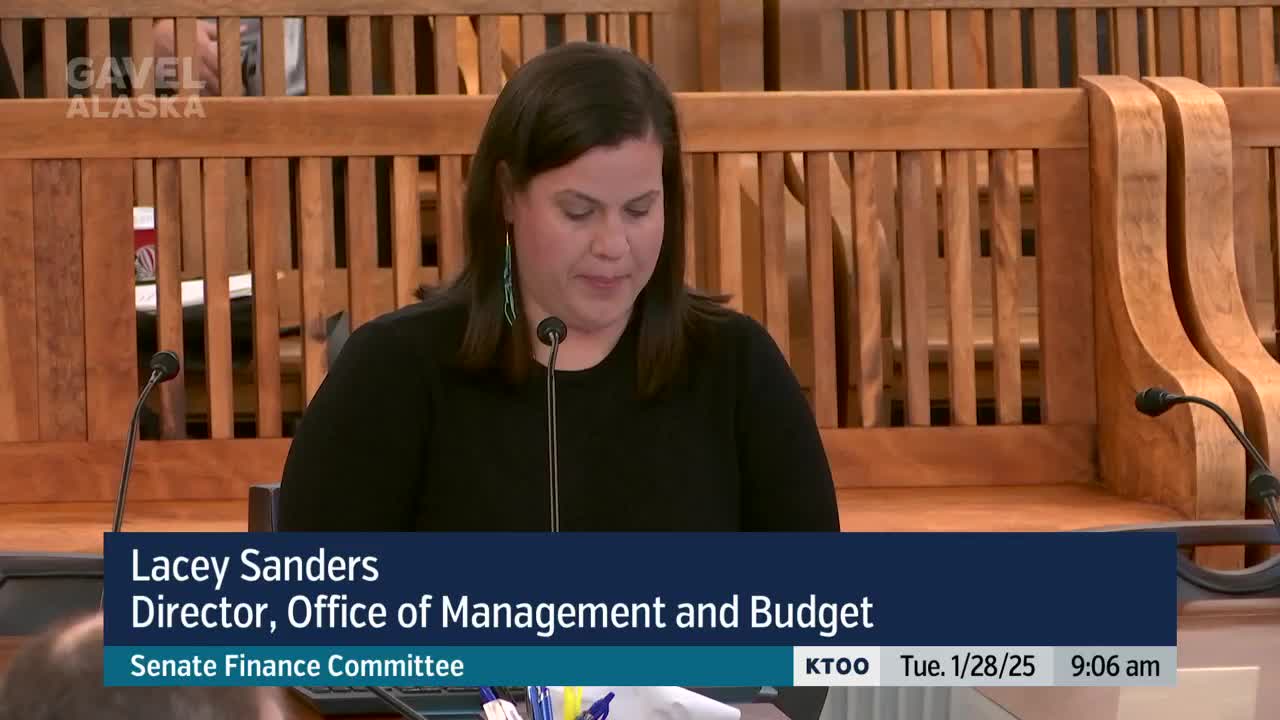
At a January meeting of the Alaska Senate Finance Committee, Office of Management and Budget Director Lacey Sanders and Legislative Finance Director Alexi Painter told senators the state faces a structural budget shortfall that will deplete savings over the coming decade unless the Legislature and governor take action.
"The status quo is clearly unsustainable," Lacey Sanders, director for the Office of Management and Budget, said, adding that "some combination of revenue measures and reductions in spending will have to occur before the state savings accounts are depleted." Sanders also said the governor is willing to participate in those conversations but is not proposing new revenue measures this year.
The warning landed in the nut graf: Legislative Finance's model and the governor's 10-year outlook both project growing deficits under current policy choices, and both offices said the state will need either new revenue or spending reductions to avoid drawing down the Constitutional Budget Reserve (CBR) and the Permanent Fund's earnings reserve (ERA).
Alexi Painter, director of the Legislative Finance Division, told the committee the fall revenue forecast showed lower oil prices and production and higher lease expenditures, which together reduced expected revenue. "Even if we hit the original $78 that was forecast last year, based on the higher cost, lease expenditure forecast, we'd have about $90 million less in revenue," Painter said. He added that the governor's FY2026 budget assumes some draws from reserves and a statutory Permanent Fund dividend that together would use a substantial portion of the CBR over the next two fiscal years.
Committee members pressed for detail on specific items that will affect near-term balances. Senators discussed the size of the projected shortfall for FY2025 (Legislative Finance reported an $8.15 billion deficit before supplementals in one slide when showing how prior-year assumptions changed with the fall forecast) and asked what oil price would be required to break even. Painter said an annual average oil price near $76 per barrel would be needed for existing FY2025 appropriations to be paid without drawing additional reserves; about $81 a barrel would be needed to trigger an energy relief provision built into last year's appropriations.
Senators and staff also discussed options for the Permanent Fund dividend formula. Sanders repeated that the governor is not proposing new revenue measures in the 10-year plan and that prior proposals had met limited legislative appetite. Senator Stedman asked directly for the governor's position on the dividend and whether the governor's arithmetic "works;" Sanders said she would bring senators' questions back to the governor.
Painter and Sanders outlined several line items and risks that affect the near-term outlook: a governor's supplemental (fast track) that requests $50 million in unrestricted general funds (UGF) for the Alaska Industrial Development and Export Authority for an LNG contract and $15 million for the disaster relief fund (double the amount the governor vetoed last year); a $10 million multiyear appropriation for the Alaska Seafood Marketing Institute; and a possible CBR draw of up to $200 million for FY2025 to cover enacted appropriations if the fall forecast is borne out.
They identified routine supplementals that will likely return this session, including fire suppression, Department of Corrections costs, and Medicaid shortfalls. Painter said recent reports show enacted fire suppression funding was nearly exhausted before the spring fire season and that the governor's proposed amount is below the multi-year average, meaning a supplemental is likely.
On capital needs, Painter warned the governor's proposed capital budget of roughly $280 million (UGF component and federal match combined) is far smaller than the state's deferred maintenance backlog, which he said is on the order of $2 billion; he used the Fairbanks Pioneer Home as an example of a facility that likely needs full replacement, not a short-term repair. "If you want to try to eat into that backlog, you're going to need to fund something closer to, you know, at least 1 or 2% of the value of state assets," Painter said.
Panelists and senators flagged the ERA sufficiency for statutory POMV (percent-of-market-value) draws. Painter noted a correction to Permanent Fund return figures used in the fall forecast that reduced projected statutory dividend amounts by about $50 million. He and Sanders said that under current statutory inflation-proofing and POMV rules, the ERA could be insufficient in the early 2030s unless policy changes are made. Painter described the trade-off: full statutory inflation-proofing lowers the risk of short-term cash shortfalls but increases the risk that a future legislature will overdraw the ERA during years of large realized gains.
Pension and payroll costs also appeared as drivers. Legislative Finance showed a projected large increase in state contributions toward PERS/TERS past-service costs and flagged pending union contract settlements that could add tens of millions in additional cost if fully funded.
No formal votes or motions on policy changes or revenue measures were taken during the meeting. The committee scheduled follow-up briefings and questions for both OMB and Legislative Finance.
The session closed with committee members urging more engagement from the administration and continued conversation between the governor and Legislature about revenue options, dividend formulas and sustainable long-term budget assumptions.
Ending note: The committee was told that final budget choices this session will include trade-offs among dividend levels, reserve draws, capital investment and recurring program spending, and that absent new revenue or substantial program reductions the state faces a persistent structural gap over the 10-year window.