Get Full Government Meeting Transcripts, Videos, & Alerts Forever!
Get email alerts on the Sidewalk Vending topic
No spam. Unsubscribe anytime.
Sacramento County presents sidewalk vending ordinance with safety, licensing and park concessions
Summary
County staff presented a proposed sidewalk vending ordinance to the Environmental Commission ahead of a Board of Supervisors hearing; the proposal sets licensing, health-permit and location rules, a $61 annual business license fee, and directs regional parks to pursue concession agreements.
Sacramento County staff told the Environmental Commission on Monday that the county will present a package of sidewalk vending regulations to the Board of Supervisors the following day, and that the rules would combine business licensing, food-safety permitting and changes for vending in regional parks.
The proposed ordinance creates two business-license categories — stationary and roaming vendors — and requires anyone selling food to obtain a health permit for a compact mobile food operation (CMFO). County staff said the draft ordinance would apply business licensing to unincorporated Sacramento County while the health-permit requirements would apply countywide.
Janae Monasterio, director of the county Environmental Management Department, said the package is intended to implement the state Safe Sidewalk Vending Act while protecting public health and safety. “The goal of our ordinance is to provide a clear pathway for the people that want to vend on the sidewalks…while balancing that with public health and safety,” Monasterio said.
The draft ordinance includes operational restrictions that county staff described as safety-based. Among the distances and limits listed in staff slides and the public presentation: a 200-foot buffer from libraries, police stations and government buildings; 100 feet from outdoor dining areas; 20 feet from crosswalks; 45 feet before and 5 feet after bus stops; 15 feet from fire hydrants and driveway aprons; 10 feet from a business during business hours; and a minimum 18 inches of pedestrian passage from the curb edge. Staff also proposed prohibiting vending on bicycle-only paths and on sidewalks with slopes greater than 5 percent.
Chad Rindy, director of the Department of Finance (presenting for Laura Jacobson), told the commission the business-license fee proposed for board consideration is $61 annually; Rolando Villarreal, division chief for environmental health, said the county will use an existing CMFO health-permit category currently billed at $381 annually while staff complete a fee evaluation.
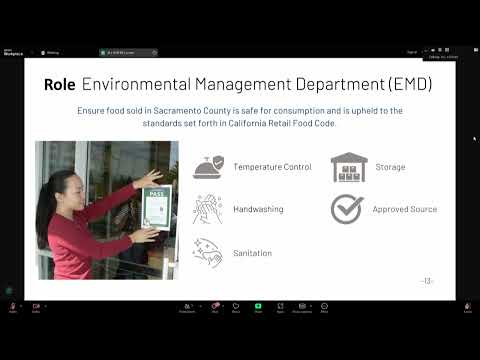
Villarreal described common health problems EMD inspectors find at unpermitted food vending operations: lack of handwashing, no temperature control or refrigeration, no approved commissary, and limited access to restrooms. “We see a lot of these tents…no refrigeration, no way to keep time and temperature control,” he said, adding that EMD can impound food it determines to be contaminated or unfit for consumption.
For enforcement, staff said they will emphasize education and outreach first and rely on the administrative-penalty schedule defined in state law for repeat violations. The state-prescribed schedule cited in the presentation includes graduated fines for operating without a license ($250 first, $500 second, $1,000 subsequent within a year) and separate administrative schedules for business-license and health-permit code violations. Staff said penalties may be reduced if vendors obtain required licenses within 10 days of a violation.
Parks staff proposed using concession agreements to manage vending inside Sacramento County regional parks, where concessionaires would be permitted spaces and the county could set time, place and manner restrictions. Monasterio said the parks concession approach is intended to avoid “a free for all” in the parks and allow the county to manage the number and placement of vendors.
Public commenters and advisory-group representatives raised concerns about how vending would operate in the American River Parkway and other sensitive natural areas. Betsy Wyland, speaking for the American River Parkway Association and as a representative attending for a Parkway Advisory Committee member, urged bilingual outreach and said the Parkway’s existing management plan treats commercial activity differently than other county parks. “All parks are not created equal,” Wyland said, asking how concession agreements and the ordinance would preserve Parkway ecology and visitor experience.
Commissioners pressed staff on outreach to vendors. Staff said they had held two recent public outreach sessions for the business community and invited park advisory groups, but acknowledged they had limited direct contact with existing sidewalk vendors and plan extensive education, including workshops in English and Spanish. Monasterio said the county has already run education and training for food vendors since the retail food-code changes and will expand outreach during implementation.
Monasterio and staff reminded the commission that the state laws that limit local authority — including SB 946 (the Safe Sidewalk Vending Act) and more recent changes like SB 972 — define many of the permissible local rules, and that the county’s ordinance seeks to align the county code with the retail food code and state statutes.
The county scheduled the first reading of the ordinance package before the Board of Supervisors for 10:30 a.m. on Jan. 28. Monasterio told the commission staff will return for additional board steps if the supervisors request revisions.
Staff said the implementation approach centers on interdepartmental coordination — business licensing, environmental management, regional parks, code enforcement, the sheriff’s office and economic development — and repeated that education will be a priority before escalating to penalties or license revocation for egregious or repeated violations.
If adopted by the Board of Supervisors, the county would impose the business-license and health-permit requirements, enforce the operational buffers and safety standards listed in the draft ordinance, and expect concession agreements to govern vending inside county regional parks.