Get Full Government Meeting Transcripts, Videos, & Alerts Forever!
Get email alerts on the Net Metering Distributed Generation topic
No spam. Unsubscribe anytime.
Committee approves net‑metering expansion for commercial users; bill advances to floor
Summary
Representative Scott Heiner, sponsor of House Bill 183 and a Republican from House District 18, told the Minerals, Business & Economic Development Committee the bill raises the net‑metering ceiling for nonresidential customers and allows aggregation of colocated meters.
Representative Scott Heiner, sponsor of House Bill 183 and a Republican from House District 18, told the Minerals, Business & Economic Development Committee the bill raises the net‑metering ceiling for nonresidential customers and allows aggregation of colocated meters.
"If an individual puts a rooftop solar or ground based solar panel at their residence or small business, they can have up to 25 kilowatts with current law," Representative Scott Heiner explained. "This bill changes that threshold ... for a small business, they will be able to go up to 200 kilowatts." He described aggregation rules that let multiple meters on the same premises and same rate schedule combine generation capacity.
Supporters — including farmers, ranchers, municipal officials and conservation groups — said expanding net metering to 200 kilowatts for nonresidential customers and allowing meter aggregation would let airports, school districts, small businesses and agricultural operations use more rooftop or on‑site solar and avoid larger utility‑scale land impacts. Several witnesses said rising electricity bills make distributed generation a practical hedge.
Tim Teichert, a Cokeville rancher who said his irrigation pumping bill exceeds $80,000 a year, told the committee he had an approved federal REAP grant but the 25‑kilowatt cap prevented a financially viable installation. "We're not a commercial provider. . . I would just hope that you would approve this bill. I think it would definitely level the playing field," Teichert said.
Municipal and conservation witnesses said the change could keep taxpayer dollars local. John Burrows of the Wyoming Outdoor Council and Monica Leininger of The Nature Conservancy in Wyoming told the committee that distributed generation reduces demand for long new transmission lines and large ground‑mounted solar arrays. Burrows noted other states allow much larger net‑metered systems for nonresidential customers and aggregate meters.
Utilities and the Public Service Commission asked the committee to preserve the commission's ability to set rates that protect all customers and to provide clearer guidance on how the "avoided cost" true‑up at year end should be calculated. Chris Petrie, deputy chairman of the Public Service Commission, said the commission will collect annual reporting on net‑metering activity and can provide system‑level capacity statistics as the program grows. Montana‑Dakota Utilities and the Wyoming Rural Electric Association raised concerns about cross‑subsidization and urged careful rate design.
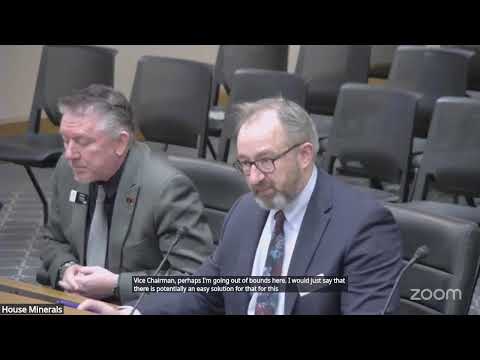
The committee moved House Bill 183, Representative Schmidt made the motion and Representative Volley seconded. The recorded roll call in committee listed named ayes and two excused members (Representative Campbell and Representative Riggins). The chair announced, "74 with 2 excused, this passes," and the committee sent HB 183 to the floor.
The bill keeps the 25‑kilowatt cap for residential customers, raises the nonresidential cap to 200 kilowatts, allows aggregation of colocated meters on the same feeder and rate schedule, and requires reporting when statewide net‑metering capacity reaches a statutory threshold. Supporters said the bill is unlikely to produce rapid saturation in Wyoming (the sponsor noted about 0.6% current penetration) and includes reporting language so the legislature and regulators can respond if distributed generation grows toward a higher share of the grid.