Get Full Government Meeting Transcripts, Videos, & Alerts Forever!
Get email alerts on the Merchant Codes Firearms Privacy topic
No spam. Unsubscribe anytime.
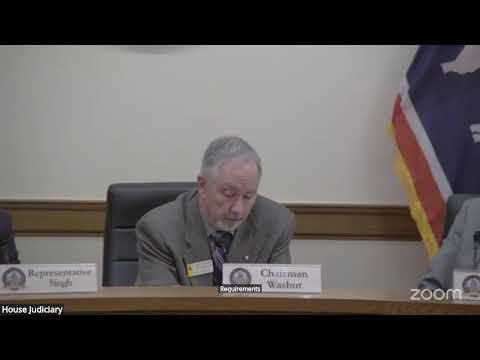
Committee advances bill aimed at restricting merchant codes for firearm sales, adds enforcement provisions
Summary
Representative Jamie Lean presented amendments to the 2nd Amendment Financial Privacy Act, proposing new definitions, penalties and a ban on using state funds to help create payment-card-based registries tied to firearm purchases.
Representative Jamie Lean presented House Bill 234 to the Judiciary Committee as an update to the 2nd Amendment Financial Privacy Act passed in 2023. The sponsor said the amendments add definitions, civil and criminal penalties, and change several provisions to require the Attorney General to investigate and enforce violations.
"We're going to create 914405...this is where the criminal actions come in and then the definitions used to go with it," Lean said, summarizing the bills structure and explaining that the changes would clarify definitions such as "firearm," "firearm accessory," "merchant," and "payment card."
Key provisions in the draft presented to the committee included:
- A prohibition on using state funds to "enforce, administer, or cooperate with" any federal or other program that "willfully keeps or causes to keep any list, record or registry of privately owned firearms" created through merchant codes or other payment-card classifications. The draft explicitly exempted records federal law requires of licensed federal firearms dealers, citing 18 U.S.C. 922.
- Definitions for merchant-category distinctions and language forbidding merchants from discriminating against firearm retailers by declining lawful payment transactions or charging higher fees based solely on merchant codes.
- Replacement of permissive enforcement language ("may") with mandatory language ("shall") for the Attorney Generals investigatory role and newly described civil and criminal penalties.
Committee testimony described two main lines of concern and support. Scott Meyer, representing the Wyoming Bankers Association, told the panel that merchant category codes are assigned by industry standards (the International Organization for Standardization was discussed in testimony) and generally implemented by payment processors, not by local banks or merchants. Meyer urged caution on enforcement language and objected to a private civil cause of action in the bill, calling such litigation a possible vehicle for "legalized extortion" because parties will threaten suits that often settle for small amounts.
Mark Jones, national director with Gun Owners of America, supported the bill and said similar laws have been passed in other states. He described the merchant code approach as the first step in a broader effort by some international standards groups to identify and target firearm sellers for de-banking, and he urged stronger, enforceable state protections to prevent merchant codes from singling out small gun retailers.
During committee debate members discussed the bills potential impacts on law enforcement recordkeeping and the Attorney Generals workload. Representative Chastick asked whether the measure could conflict with federal requirements; the sponsor and witnesses pointed to the bills express carve-out for records federal law requires for federal firearms licensees (18 U.S.C. 922).
The committee considered multiple amendments. Representative Schastick moved to strike a private cause-of-action provision that would allow private suits if the Attorney General did not act; sponsors and some bankers said that language risked frivolous or extortionate litigation. The committee debated and ultimately defeated that amendment (motion failed). Representative Singh moved to extend a 60-day AG response window to 180 days; that motion resulted in a tie and did not pass. Members also discussed whether enforcement mandates would create an unfunded workload for the Attorney Generals Office.
Witnesses and members repeatedly raised the voluntary nature of merchant category codes and the practical limits of payment processors control. Scott Meyer said processors and card networks, not local banks or merchants, control codes and that the codes are optional industry standards primarily used for rewards and pricing. He warned that if a large processor decided to stop processing certain merchant codes it could leave little local recourse.
Representative Webb moved to advance the bill; Representative Brady seconded. On roll call the committee reported seven ayes, one no and one excused, advancing House Bill 234 to the floor.
Clarifying details included: the bill explicitly preserves records federal law requires of federal firearms licensees (18 U.S.C. 922); sponsor and witnesses described merchant category codes as set by industry bodies and implemented by payment processors; and committee members expressed concern about the bill creating an unfunded enforcement mandate for the Attorney Generals Office.
The measure now moves to the full House; sponsors said they may continue technical drafting and follow-up with the Attorney Generals Office on enforcement resourcing.