Get Full Government Meeting Transcripts, Videos, & Alerts Forever!
Get email alerts on the Tourism Economy topic
No spam. Unsubscribe anytime.
Rock and Roll Hall of Fame details $175 million expansion as tourism leaders urge continued state marketing support
Summary
Greg Harris, president and CEO of the Rock and Roll Hall of Fame, updated the Ohio House Arts, Athletics and Tourism Committee on a $175 million expansion project and economic contribution figures, and leaders from hotels, restaurants, state travel and local convention and visitor bureaus told the committee that continued investment in TourismOhio and local destination marketing drives visitor spending and jobs statewide.
Greg Harris, president and CEO of the Rock and Roll Hall of Fame, told the Ohio House Arts, Athletics and Tourism Committee on May 6 that the museum is expanding to accommodate more visitors and to drive additional economic activity for Cleveland and the state.
Harris said the Rock and Roll Hall of Fame has welcomed about 15,000,000 visitors since it opened and that those visits have produced a cumulative economic impact of approximately $2,500,000,000. "We have an annual operating budget of roughly $35,000,000," Harris said, and he described the museum as both an arts institution and a tourism anchor for Northeast Ohio. He said the expansion project is budgeted at $175,000,000, of which the museum has raised about $165,000,000 — roughly $148,000,000 in private dollars and $17,000,000 from the state — and that the new wing will include a 50,000-square-foot entry, unticketed public spaces and a 1,400-capacity performance space.
The Rock Hall presentation led into a tourism roundtable featuring leaders from the sector who emphasized tourism's statewide economic footprint and urged continued funding for destination marketing. Melinda Huntley, executive director of the Ohio Travel Association, summarized state and industry data for 2023, saying visitors spent about $43,000,000,000 in the state and that an additional roughly $13,000,000,000 was spent by businesses serving those visitors, producing a combined figure of about $56,000,000,000 in economic activity. Huntley added that tourism supports nearly 436,000 jobs statewide and generated approximately $4,600,000,000 in state and local tax revenue in 2023. She told the committee that TourismOhio's advertising generated an estimated 703,000 trips and about $217,000,000 in visitor spending in 2023, and she summarized the campaign’s measured return: "for every dollar invested in TourismOhio's campaign, $60 in direct visitor spending and $5 in state taxes are generated."
Joe Savaris, president and CEO of the Ohio Hotel and Lodging Association, told the committee the lodging sector remains a major contributor to the travel economy. "Ohio is home to more than 1,600 licensed and active hotel properties," Savaris said; he added the industry provides roughly 142,000 rooms and directly employs more than 36,000 people while supporting broader hotel‑related employment. Savaris cautioned that rising operating costs and layered local lodging taxes affect competitiveness and new hotel investment, and he urged lawmakers to preserve the current lodging‑tax funding model that supports local destination marketing.
Todd Bowen, managing director for external affairs and government relations at the Ohio Restaurant and Hospitality Alliance, emphasized the role of restaurants and food service in the visitor experience. Bowen said Ohio has about 24,821 eating and drinking establishments employing roughly 564,000 people and that restaurant spending is a substantial multiplier in local economies.
Andy Herff, executive director of the Ohio Association of Convention and Visitor Bureaus, described how local CVBs (also called destination marketing organizations) are funded and governed and how lodging taxes feed local marketing efforts. He noted that CVBs are audited and that their boards typically include local government and industry representatives. "CVBs are economic drivers in their areas," Herff said, adding that effective local marketing can spur additional lodging and other tourism investment.
Committee members asked the panel about what visitors want and how Ohio can attract larger conventions and sporting events. Panelists urged stronger collaboration among communities, targeted marketing for specific interests and continuation of state funding that helps communities compete for events. Representative McNally asked whether Ohio lacks infrastructure or funding to attract larger events; the panel pointed to both built‑environment advantages and the need for competitive promotional and incentive funding in some cases.
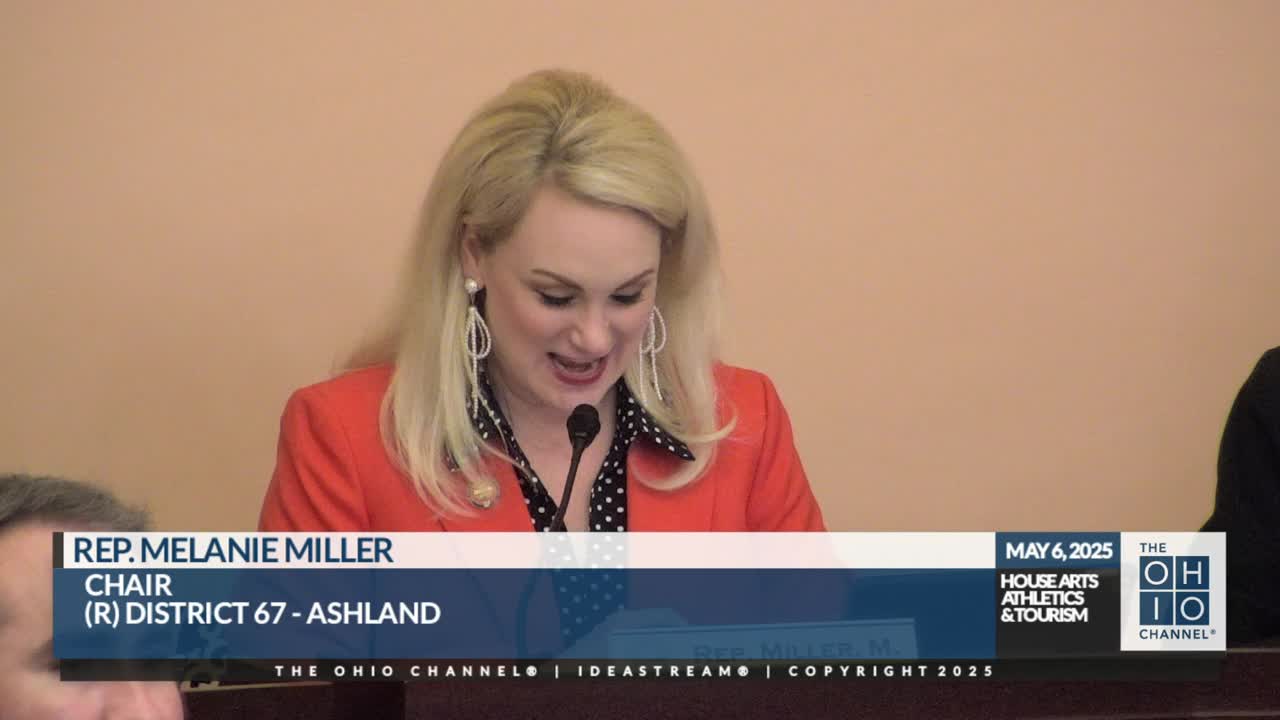
The committee chair, Chairwoman Miller, thanked the presenters and invited committee members to consider a site visit to the Rock and Roll Hall of Fame. No formal votes or legislation were taken during the meeting.
Notes and direct quotes in this report are drawn from testimony before the Ohio House Arts, Athletics and Tourism Committee on May 6, 2025.