Get Full Government Meeting Transcripts, Videos, & Alerts Forever!
Get email alerts on the Biofuels Grants Audit topic
No spam. Unsubscribe anytime.
Legislative auditors praise bio‑incentive payments but find problems in biofuels infrastructure grants
Summary
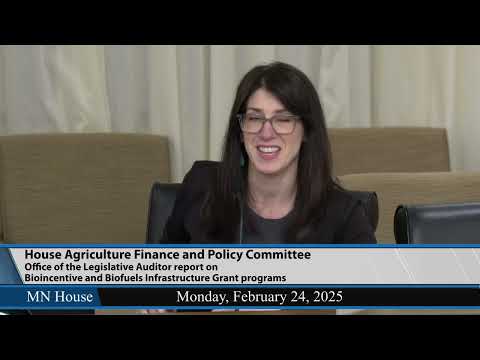
The House Agriculture Finance and Policy Committee on Tuesday heard a performance audit from the Office of the Legislative Auditor of two Minnesota Department of Agriculture programs: the bio‑incentive payments program and the biofuels infrastructure grant program.
The House Agriculture Finance and Policy Committee on Tuesday heard a performance audit from the Office of the Legislative Auditor of two Minnesota Department of Agriculture (MDA) programs: the bio‑incentive payments program and the biofuels infrastructure grant program.
The Office of the Legislative Auditor found that the bio‑incentive payment program — which issues incentives to in‑state producers for commercial‑scale production of renewable energy and renewable chemicals — was operating in compliance with applicable requirements. "We completed our audit work on this program and we didn't find anything out of compliance for the department," said Valentina Stone, a manager on the audit project.
But auditors identified two areas of concern in the biofuels infrastructure grant program, which made competitive awards to retail fueling stations to enable them to dispense fuel containing at least 15% ethanol. Stone said auditors found that the department paid about $19,000 for costs not associated with qualified equipment, about $358,000 for costs that deviated from grantee budgets (including vendor payments not specified in budgets), and roughly $13,000 to a grantee for equipment ordered before the contract was executed. Auditors also found that required progress reports were often missing or insufficient: "None of the grantees submitted reports in fall 2022 and 27 out of 44 grantees did not submit those required reports in 2023," Stone said, noting that the department's report templates did not always capture project progress.
The audit covered activity from July 1, 2021, through Jan. 31, 2024. Stone said the department made about $12.1 million in bio‑incentive payments during the period and that the department awarded $6.48 million in biofuels infrastructure grants across 44 projects; as of the audit cutoff, the department had paid roughly $2.33 million for 15 completed BIP projects.
Deputy Legislative Auditor Lori Lisonbee told the committee the auditors generally view grant administration as an area that frequently yields findings and praised MDA for some strong controls: "They don't advance money ahead of time. They have a 10% retainage and they actually went on‑site to their grantees," Lisonbee said.
MDA Deputy Commissioner Andrea Vawbel told the committee the agency "generally agree[s] with the findings and will promptly address the recommendations," and said the department had implemented many conservative controls beyond what the Office of Grants Management requires, including two‑staff signoffs on larger payment requests and site visits on grants over $25,000. Vawbel said the OLA reviewed roughly $14.5 million in expenditures across the two programs and that "only $18,894 is recommended to be reclaimed," and she said MDA has followed the recommendation and substantially recovered that amount from grantees.
Committee members asked whether the department withheld payments when progress reports were missing. Stone said the office of grants management policy calls for withholding payments from grantees that fail to submit required progress reports, and the auditors recommended MDA stop making payments until progress reports are received. Stone added that, in follow‑up, auditors found two grantees had ceased project work because costs rose above expectations.
The committee packet included written testimony from industry groups including the Minnesota Corn Growers and the Minnesota Biofuels Association; department staff and OLA auditors told lawmakers they would address the recommendations and continue to monitor these programs.
The audit presentation preceded the department's budget and policy briefing, and auditors and MDA staff answered members' questions about payments, monitoring, and the department's plans to implement OLA recommendations.