Get Full Government Meeting Transcripts, Videos, & Alerts Forever!
Get email alerts on the Stem Prerequisites topic
No spam. Unsubscribe anytime.
Board meeting draws dozens of speakers as updated guidance on STEM prerequisites sparks debate
Summary
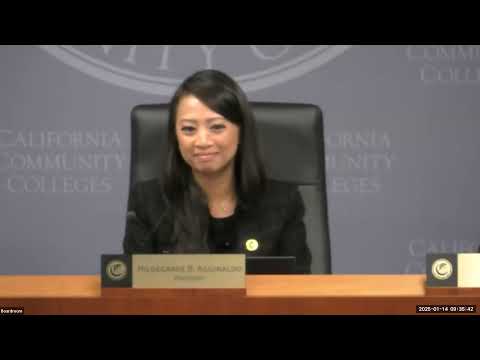
Updated guidance from the chancellor's office on AB 17o5 and STEM placement prompted hours of public comment at the California Community Colleges Board of Governors meeting on Jan. 14, with faculty, students and civil-rights advocates sharply divided about whether colleges should offer preparatory courses such as trigonometry and precalculus before students enroll in calculus 1.
Updated guidance from the California Community Colleges Chancellor's Office on AB 17o5 and STEM placement touched off hours of public comment at the Board of Governors meeting on Jan. 14, with faculty, students and civil-rights advocates sharply divided about whether colleges should offer preparatory courses such as trigonometry and precalculus before students enroll in calculus 1.
The board heard packed public testimony both supporting and opposing the chancellor's December memo, which allows colleges to validate preparatory STEM courses for students who demonstrably need them while preserving students' right to enroll directly into calculus when appropriate.
Supporters at the meeting said the guidance returns agency to students and campus faculty while giving colleges flexibility to serve diverse learners. Anna Matthews, government relations director for the Faculty Association of California Community Colleges, said the memo 'embodies our commitment to equity' and gives historically underrepresented students additional routes into STEM majors. Catherine Stitt, AB 17o5 coordinator and math faculty at Diablo Valley College, told the board she and students who voted in a campus survey favored the option to take preparatory courses prior to calculus, because 'there's simply too much underlying knowledge that you need before starting calculus.'
Other campus faculty described classroom experience that matched the memo's rationale. Math professor Karen Cliff of Southwestern College recounted follow-up interviews with students who had been placed directly in calculus with support; several students told her they 'wished I had taken precalculus to start with,' and some who failed subsequently dropped out. That testimony underscored the practical effect of placement choices, Cliff said: 'Behind the numbers are real students, and our guidance to those students has a huge impact on their futures.'
Opponents, including civil-rights and student-advocacy groups, warned the guidance could reintroduce barriers AB 17o5 (the statute giving eligible students the right to enroll in calculus) was designed to remove. Jeton Stevens, a senior attorney at Public Advocates, said the chancellor's office 'walks away from this evidence-based policy, creates exceptions that don't exist and permits colleges to ignore the rights of vulnerable STEM students.' Melissa Barto of Education Trust West cautioned that longer prerequisite sequences disproportionately keep Black and Latinx students out of STEM pathways, citing state research showing large gains in transfer-level course completion after statewide reform.
Board members listened but did not alter the memo at the meeting. Several governors praised the chancellor's office for trying to strike a balance between student choice and course readiness; others said they wanted more data. The argument at the dais echoed testimony in the room: faculty and campuses stressed local classroom realities and student preparedness; student-advocacy groups and some higher-education advocates emphasized statewide equity and enforcement of AB 17o5's statutory protections.
What the memo says and what it means: the chancellor's December guidance allows colleges to validate preparatory stem courses for students who need them while preserving a student's ability to enroll directly into calculus. Supporters call this pragmatic and equity-minded; opponents say the change risks re-creating enrollment gates that the law aimed to remove.
The debate is likely to continue. Dozens of public speakers asked the board to clarify whether the memo would be enforced systemwide and how colleges would be held accountable to AB 17o5's student-rights provisions. A number of faculty associations, student governments and local academic senates offered written and oral positions; public comment included hundreds of individual speakers representing students, instructors and administrators at community colleges across the state.
For now, the chancellor's memo remains the state-level guidance. Colleges, campus faculty and student groups said they will press for clearer implementation rules and data reporting to track the guidance's effect on enrollment, retention and transfer into STEM majors.
Ending note: Board members and chancellor's staff said they would continue collecting campus and system data and promised follow-up briefings; several governors asked staff to return with updated implementation guidance before the next major enrollment deadlines.