Get Full Government Meeting Transcripts, Videos, & Alerts Forever!
Get email alerts on the Housing Budget topic
No spam. Unsubscribe anytime.
Santa Rosa Housing Authority kicks off 2025-26 budget process amid HUD funding uncertainty
Summary
The City of Santa Rosa Housing Authority on Jan. 27 began its fiscal year 2025-26 budget process while warning that final federal allocations from HUD are not yet known.
The City of Santa Rosa Housing Authority on Jan. 27 began its fiscal year 2025-26 budget process while warning that final federal allocations from the U.S. Department of Housing and Urban Development (HUD) are not yet known.
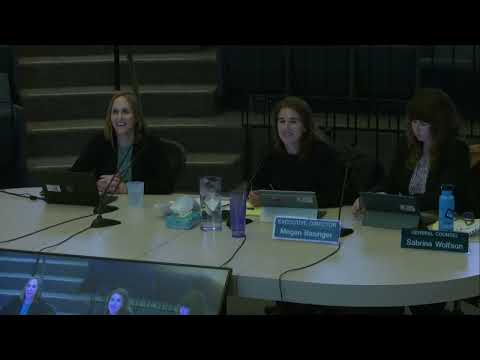
Megan Basinger, executive director of the Housing Authority, and Kate Goldfein, the authority’s administrative services officer, presented projected revenue sources, spending assumptions and a schedule that would bring a finalized housing authority budget back to commissioners for adoption in June.
The presentation laid out local, state and federal revenue assumptions and the authority’s approach to uncertainty from the federal level. “We have not received any communications from HUD on what they will be in the upcoming fiscal year,” Basinger said. Kate Goldfein described local revenue expectations and conservative budgeting choices: “We always budget these really, really, really conservatively,” she said of impact fees, adding that the authority is planning for loan repayments and other smaller local revenues.
Why this matters: Santa Rosa’s housing programs rely on a mix of federal entitlement dollars, state grants and local fees to fund rental assistance, affordable housing loans and compliance monitoring. Delayed or prorated HUD funding can constrain voucher utilization and administrative capacity, affecting the authority’s ability to place households and to monitor affordability requirements.
Key budget assumptions and details
- Local revenue assumptions discussed included real property transfer tax allocations (the authority’s share is determined by City Council policy), developer-paid housing impact fees (budgeted conservatively at $130,000) and an expected $201,000 in compliance monitoring fees as more units come online. Goldfein said the authority will also conservatively budget roughly $100,000 for loan repayments. She also said the housing authority will receive a $456,000 Permanent Local Housing Allocation state grant as the final year of a five-year cycle.
- Federal programs that typically fund the housing trust include CDBG (Community Development Block Grant), HOME Investment Partnerships (HOME), and HOPWA (Housing Opportunities for Persons With HIV/AIDS). Goldfein said national budget proposals showed largely flat funding for CDBG and HOPWA and a split picture for HOME, so the authority is keeping those program budgets flat until local entitlements are confirmed.
- The housing choice voucher program remains the department’s largest federal-funded component. Goldfein explained that HUD sometimes prorates administrative fees and voucher funding; the authority recently was notified that payments and administrative fees for January and February would be funded at prior-year levels, but future months await HUD’s final budget. She also noted that Emergency Housing Vouchers (EHV) created under the American Rescue Plan cannot be reissued when relinquished and therefore will decline over time.
- Expenditure assumptions include expected salary increases (the second year of a three-year increase and a 4% cost-of-living adjustment), an anticipated additional up-to-5% salary component related to a citywide classification and compensation study, and ongoing increases in benefits and overhead (historically 5–10%). Staff said they are not requesting new positions in this budget cycle but expect higher rental assistance payments to landlords.
Budget timeline and citywide context
Goldfein walked commissioners through a compressed timeline that runs from the January kickoff to final adoption in June. The schedule aligns the housing authority process with the City of Santa Rosa’s broader budget cycle and a city council plan to consider general fund reductions to address a structural deficit. Goldfein urged commissioners that the April and June study sessions will be critical for adjustments once HUD allocations are confirmed.
Public comments and stakeholder concerns
Public commenters urged the housing authority to coordinate more closely with county behavioral health and veterans’ services and to address immediate shelter needs. Gregory Farren, who identified himself as a member of the county behavioral health board and the Measure O oversight committee, urged integrating behavioral health and substance-use services with housing: “We are beginning to think of vouchers to housing the homeless as mental health vouchers,” Farren said, arguing that some programs funded as housing should include clinical supports.
Duane DeWitt, a Roseland resident, focused on the immediate needs of people living on the street during cold weather and suggested temporary warming options on available city-owned lots. David Harris, a former housing authority member, asked the authority to study how its capital and voucher choices affect the availability of family housing and local school enrollment.
Pipeline and program updates
Executive Director Basinger highlighted the authority’s January pipeline update showing about 14 projects completed in the past 24 months totaling more than 1,200 units and additional projects that include units set aside for people exiting homelessness. Staff noted that some projects use project-based vouchers or state No Place Like Home funds to support formerly homeless tenants.
What the authority will do next
Staff said they will return with updated figures and likely policy options once HUD releases final allocations. Commissioners asked staff to include contingency plans and options for reduced federal support and to continue conversations with city and county partners about addressing immediate shelter and service gaps.
For now the Housing Authority will continue budgeting conservatively and bring iterative updates to commissioners as more definitive funding information becomes available.