Get Full Government Meeting Transcripts, Videos, & Alerts Forever!
Get email alerts on the Special Education topic
No spam. Unsubscribe anytime.
Board approves manager job description as Exceptional Student Services outlines staffing, program review
Summary
After a program review and a year of listening, the Creighton district’s Exceptional Student Services director recommended reorganizing coordinator roles into manager positions and adding an instructional coach; the board approved the manager job description.
Creighton Elementary District’s governing board voted to approve a new job description for a Manager of Exceptional Student Services after the department presented a program review that identified staffing, systems and instructional priorities.
Director Gretchen Kaiser told the board the review — which included interviews, site visits and surveys conducted between November and February — found important strengths (committed teachers, collaborative pockets of inclusive practice, functioning regional programs) and recurring needs: clearer departmental roles and responsibilities, standardized meeting and IEP/meeting facilitation structures, more curricular resources for specially designed instruction, and increased instructional-coaching capacity.
Kaiser said the department currently supports about 674 students with Individualized Education Programs (about 14% of enrollment as of the district’s 70th-day count) and 48 developmental-preschool students, plus private/home-schooled students living in district boundaries. The department also runs a continuum of regional programs (examples cited: STAR at Loma Linda; STRIDE at Excellency and Papago; RISE at Mackin; PLACES at Larry C. Kennedy) and provides related services (speech-language, OT/PT, assistive technology and motor therapy).
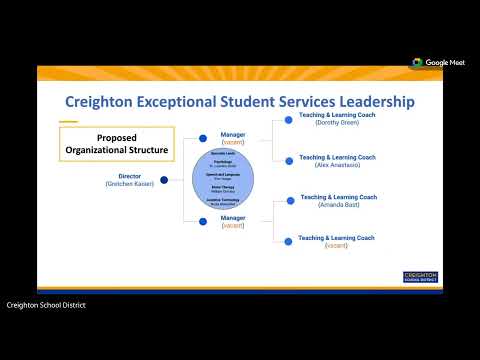
Recommended staffing and changes: Kaiser recommended reclassifying two coordinator positions to two manager-level positions (to include supervisory responsibilities and attract applicants with the needed scope of experience) and adding a full-time instructional coach to increase time coaches spend in classrooms. Kaiser said the goal is to direct 50%–80% of coach time to in-classroom coaching cycles (observation, modeling, debrief, follow-up) rather than non-instructional tasks. She also described a phased rollout of McGraw Hill Reading Mastery and Corrective Reading materials in special-education programs and an active Special Education Family Advisory Council (CFAC) launched to increase family engagement.
Board action: A motion to approve the manager job description passed by voice vote. District leadership said the change is intended to make the department more responsive to campus needs and better able to scale coaching, standardized meeting facilitation, and curricular supports for specially designed instruction.
Why it matters: The district’s students with disabilities scored substantially below state averages on some assessments; Kaiser said the department is targeted for improvement in federal monitoring. The recommended staffing changes aim to increase coaching capacity, provide clearer operational structure and accelerate implementation of evidence-based reading and early-learning practices across special-education programs.
Next steps: Kaiser and the executive team said they will continue recruiting for manager-level roles and the additional instructional coach, advance McGraw Hill implementation with vendor coaching cycles, expand CFAC membership, and refine systems to shorten response times for school teams seeking special-education support.