Get Full Government Meeting Transcripts, Videos, & Alerts Forever!
Get email alerts on the School Transportation topic
No spam. Unsubscribe anytime.
Conewago Valley board orders K–6 transportation survey after debate over 1‑mile walking zone and bus capacity
Summary
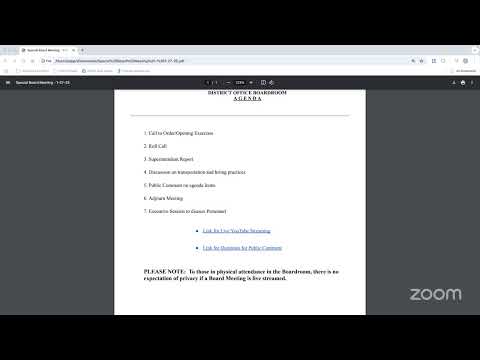
At a Jan. 27 special meeting, Superintendent Dr. Perry reviewed district walking and ridership data and proposed a survey focused on K–6 families; the board voted to send the survey and directed staff to return with bus-capacity and routing data.
The Conewago Valley School District Board of School Directors voted Jan. 27 to send a districtwide transportation survey focused on K–6 families after a wide-ranging discussion about the board’s 1‑mile walking zone, bus capacity and safety concerns.
Superintendent Dr. Perry told the board that maps of student home locations show "all of our walkers are within 1 mile radius," and said the district’s current count is 295 students who live within that mile and would be considered walkers under the board’s guidance. She presented a rough cost estimate that would, she said, amount to about $10,000 per student per year, and noted the district had previously extended the walking radius to 1.5 miles during COVID‑19 and then returned to a 1‑mile standard.
Board members said they wanted better data before considering policy changes. "We need to understand who is actually walking," said a board member. Several directors said they hear parents’ safety concerns for younger children walking on busy roads without sidewalks or crossing guards. One director said, "If we can't provide crossing guards ... give up some of the pretty furniture, and put these kids on a bus." Another director urged limiting the survey and analysis to K–6 children because they are younger and potentially more vulnerable.
Dr. Perry proposed four survey questions to identify each student’s school and grade, the family’s usual mode of arrival (car rider, bus rider, walker, high‑school driver) and whether the child stays after school for childcare, activities or music. She also suggested asking parents who usually drive why they choose that option. The board asked staff to validate the cost estimates and to return with comparative counts at 0.75 mile and 1.5 mile radii to show how different boundaries would affect the number of students eligible for transportation.
Directing follow‑up data collection, the board asked staff for: rosters showing how many students are assigned to each bus, the capacity of each bus type used by the district (standard buses, minibuses, handicap vehicles and vans), and counts of current registered riders per bus. Dr. Perry said the district operates 40 buses (two handicap‑accessible minibuses), several vans and special‑service vehicles; routes are run in separate runs (secondary and elementary) so some vehicles are used more than once per day. She also said Lincoln Transportation has reviewed routes and suggested efficiencies, but that not all buses run at full capacity; staff estimated many runs at roughly 66–75% capacity.
A motion to send the survey passed on a roll call vote with all members recorded as voting yes. Board members directed staff to release the survey promptly, run reminders over roughly a two‑week response window and present preliminary results and the requested bus‑capacity data at the regular February board meeting.
The board and staff also discussed potential mitigation options that could be evaluated if significant demand is shown: designated neighborhood pickup/drop‑off hubs within the mile, routing adjustments, and targeting crossing‑guard funding or grants to locations the survey identifies as unsafe for walking.
Dr. Perry said she would confirm which grant programs might be eligible to offset safety costs, and she will work with the human resources and transportation staff to provide the requested route, roster and vehicle capacity data. The board did not change its policy on the walking radius at the meeting; it took only the survey and data requests as formal next steps.
The district noted several caveats in the discussion: private and nonpublic school transport rules vary and nonpublic schools may run their own stops, and family choices (daycare or personal choice to drive) affect daily ridership and therefore capacity calculations. The board directed staff to validate the cost figures and to report back with the survey results and bus capacity/roster details for each school by the February regular meeting.