Get Full Government Meeting Transcripts, Videos, & Alerts Forever!
Get email alerts on the Infrastructure Sewer topic
No spam. Unsubscribe anytime.
Paradise sewer project costs balloon; council hears options to scale back and consider local treatment
Summary
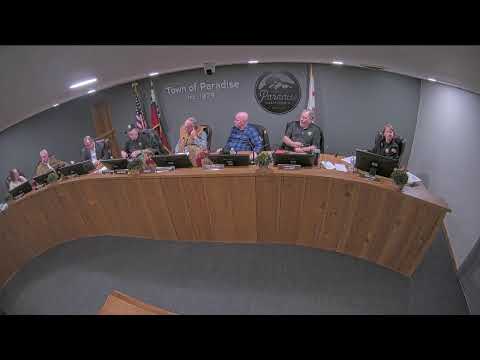
Paradise Town Council on Dec. 10 heard that the previously planned regional sewer connection to Chico has become financially infeasible, with updated construction estimates in the hundreds of millions of dollars, prompting staff to present scaled local alternatives and a plan for community input.
Paradise Town Council on Dec. 10 heard a detailed update on the Paradise Sewer Project showing sharply higher cost estimates and discussing a possible pivot from a regional connection to local treatment and phased service areas.
Town public works director Mark Maddox presented the basis-of-design work completed by the town’s progressive design-build team and told the council the project as currently scoped — a regional export pipeline and collection system that would connect to the City of Chico’s treatment plant — is “financially infeasible” given current funding availability and revised cost estimates.
The presentation summarized past studies and funding secured to date and then laid out recent funding and permitting realities that have driven the team to consider smaller, local treatment options. Maddox said design work, a programmatic environmental impact report and a signed agreement with Chico produced needed technical detail but also revealed that costs have increased far beyond early estimates. “We are not on track to secure $450 million in grants to pay for the project as it is currently scoped,” he said.
Why it matters: the sewer project is central to rebuilding downtown and higher-density housing that the town’s recovery plan anticipates. Council members and residents said rapid clarity about scope, costs and likely per-parcel impacts will be crucial for decisions and for recovering population and commerce.
What the update said - Updated construction cost range: Maddox told the council current estimates are in a range “over $400 million to $480 million.” - Secured and committed funding to date (presented by staff): a $30 million state CDBG-DR planning grant, $16 million in CDBG-DR construction allocation, $1.75 million in congressionally directed EPA funds, and about $2.8 million from the State Water Board’s Division of Financial Assistance. A $800,000 USDA grant was also noted for preliminary work. - Schedule: the project team is preparing a basis-of-design report for council review early next year; earlier planning had targeted construction completion by 2031 under the regional plan. - Funding outlook: Maddox said state and federal budget pressures and high demand from other projects make it unlikely the town will secure full project funding for the regional option in the near term.
Staff and the design-build team recommended pursuing a set of scaled alternatives that could be permitted and funded more readily. Those options included: (1) a downtown-focused collection system feeding a local treatment plant (safer permitting and shorter pipework), (2) phased service areas that connect highest-benefit parcels first (for example downtown and nearby infill parcels), and (3) re-evaluating dispersal options for treated effluent (land application, beneficial reuse, or surface-water discharge), each with different technical and regulatory trade-offs.
Public comments and council reaction Several residents and stakeholders urged the council to move quickly to define scaled options and to provide tangible cost estimates that residents and businesses can understand. Bill Sherritt, a Paradise Unified School District board member, said in public comment that school construction timelines are being affected by sewer uncertainty and urged the town to meet more frequently on the issue.
Business owner Jared Kramer, who operates a downtown cafe, asked council to consider parking and access implications if downtown redevelopment accelerates once sewer service is available.
Council members requested more actionable numbers and a short list of alternatives. Council members asked staff to: - return with a menu of scaled options tied to realistic funding scenarios, and - prepare community outreach so residents can comment on trade-offs (service area, rates, phasing).
What staff will do next Maddox said staff will present the basis-of-design report early next year, produce a set of scaled alternatives (with rough cost ranges and the number of parcels served under each option), and expand public engagement. He also said the town will prioritize avoiding spending funds on work that cannot be repurposed to a revised, affordable plan.
Ending Council members and residents voiced urgency and different priorities — some urging that sewer funding be prioritized over other recovery projects, others cautioning about statewide funding limits. The presentation closed with staff saying the information is intended to enable a council decision on a revised project direction early in 2025 so design, permitting and funding work can proceed in a way that fits the town’s likely financing capacity.