Get Full Government Meeting Transcripts, Videos, & Alerts Forever!
Get email alerts on the Education District Goals topic
No spam. Unsubscribe anytime.
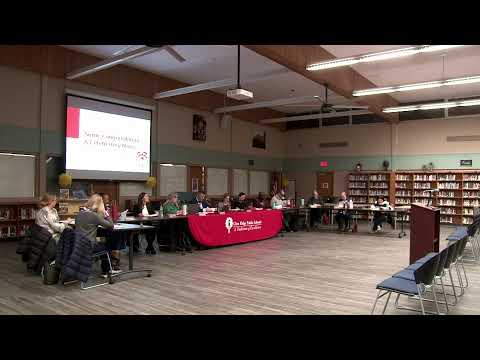
Glen Ridge superintendent reports progress on curriculum, social-emotional learning, AI and human-resources goals
Summary
Superintendent Maggie updated the Glen Ridge Board of Education on student achievements and four district goals — revising ELA curriculum, building a districtwide social-emotional learning framework, developing AI guidance for classrooms, and strengthening human-resources practices — and described next steps and pilot activities.
Superintendent Maggie told the Glen Ridge Board of Education that the district is making measurable progress on four primary goals — revising preK–12 English language arts curriculum, strengthening social-emotional learning (SEL), preparing staff and students to use artificial intelligence responsibly, and improving human-resources systems — and highlighted recent student achievements across the district.
Maggie opened with a series of student and school highlights, noting that senior Riley O’Sullivan reached 1,000 career points for the girls varsity basketball team, the 7th- and 8th-grade history club teams competed at the New Jersey State Championships with the 7th-grade team qualifying for the national championship in Orlando this May, and Glen Ridge High School received the AP Computer Science Female Diversity Award for the 2023–24 school year. She also noted community service drives and that four RAS students — Vera Roman, Dylan Meiser, Theo Reining and Emery Pollux — advanced to the next round of the National Geography Bee.
The superintendent said the district has four focal goals for the year. On curriculum, the district has surveyed teachers and convened committees to revise ELA materials; K–6 is piloting a new writing approach while grades 7–12 continue discussion on text selection and vertical/horizontal alignment across grade levels. “We identified key focus areas enhancing [writing] instruction and addressing reading lists and text selections in grades 7 to 12,” Maggie said.
On SEL, Maggie said the district is working to connect several programs into a coherent, districtwide framework. She described current activity by grade band: pre-K–2 teachers implementing classroom practice tied to the Capturing Kids’ Hearts program, grades 3–6 piloting collaborative problem solving, and grades 7–12 reviewing existing SEL efforts to identify gaps. She said next steps include progress monitoring and scaling programs where appropriate.
Regarding artificial intelligence, the superintendent said administrators and some teachers have begun exploring AI tools and classroom applications, and the district is discussing possible policy language and expanded professional development tied to upcoming half days on Feb. 14 and in March. “We want to explore potential policy and regulation language to provide a structure around our use of AI,” Maggie said. She added that some curriculum units already include explicit instruction about AI and that classroom practice should emphasize “think with AI” rather than “have AI think for you.”
For human resources, Maggie outlined recruitment outreach, development of recruitment materials, preparations for virtual and in-person job fairs, the introduction of exit interviews and plans to pilot “stay interviews” to capture feedback from current staff. She said the district is also formalizing coaching protocols and reviewing HR roles to better align them with operational needs.
Maggie said the district will prepare a fuller achievement report by the end of the school year and noted that, on the day of the meeting, the district reached the midpoint of the school year (the 89th day). She also described a continuing student superintendent committee that has met twice to discuss workload, curriculum, the use of AI, mental-health resources and the high-school cell-phone policy.
The presentation included several next-step items for board and staff: additional pilots and professional development for ELA, progress monitoring and mapping of SEL efforts, drafting AI guidance and policy language for committee review, and refinement of HR protocols and interviews to improve retention and organizational health.