Get Full Government Meeting Transcripts, Videos, & Alerts Forever!
Get email alerts on the Subdivision Ordinance Procedures topic
No spam. Unsubscribe anytime.
Planning commission members press for clearer subdivision-application and tabling rules
Summary
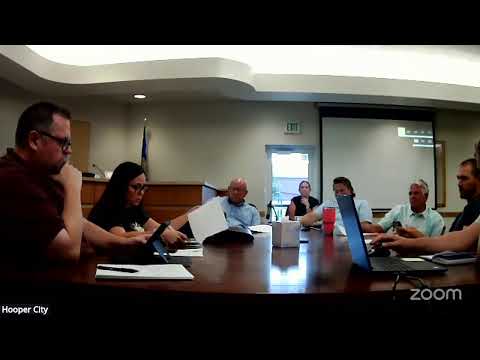
Members of the Hooper City Planning Commission discussed proposed edits to the subdivision ordinance and meeting decorum, including simultaneous distribution of subdivision applications to commissioners, removing a chair-recognition limit on questioning, and requiring a date when tabling items.
Members of the Hooper City Planning Commission discussed proposed revisions to the city's subdivision and meeting procedures intended to give commissioners earlier access to application materials and to clarify rules for questioning applicants and tabling items.
Commission members said staff should email an inclusive copy of every completed subdivision application and related documents to the planning commission at the same time the Technical Review Committee (TRC) receives materials for initial review. A commission member said that change should be inserted into the subdivision ordinance and take effect at the beginning of the next renewal cycle.
The group also debated language in the meeting rules that currently says any member of the commission 'upon recognition by the chair' may direct questions to speakers at the podium. One member asked that the phrase "upon recognition by the chair" be removed so that individual commissioners can ask applicants questions directly, citing current practice in which multiple commissioners routinely ask applicants questions during hearings.
Members discussed the practice of tabling items and whether a date must be set when an item is continued. One speaker said a person named Brandon previously advised the commission that tabled items require a return date; several members said that practice is fair to applicants and recommended specifying a date rather than leaving an item open indefinitely. Members mentioned that tabling commonly applies to conditional use permits and licensing questions where the commission needs additional information, such as state licensing requirements, before deciding.
A member recounted a separate easement dispute involving a private landowner, Travis Trim, and said that experience illustrated the importance of clear procedures and accurate record-keeping for applicants and the public. That recounting was presented as an example rather than a formal agenda item.
Speakers noted minor typographical errors in the draft and confirmed that highlighted edits had already been sent to other commissioners for review. No formal motions or votes to adopt changes were recorded in the transcript of this discussion.
The commission did not record any final decision in the excerpted discussion; members left open the need to incorporate the suggested language about distribution of application materials, revise the questioning language, and require dates when tabling items. Members said they would continue to coordinate with staff about the highlighted edits.