
IAEA warns attacks on Iran nuclear sites have degraded safety; urges access for inspectors
Get AI-powered insights, summaries, and transcripts
Subscribe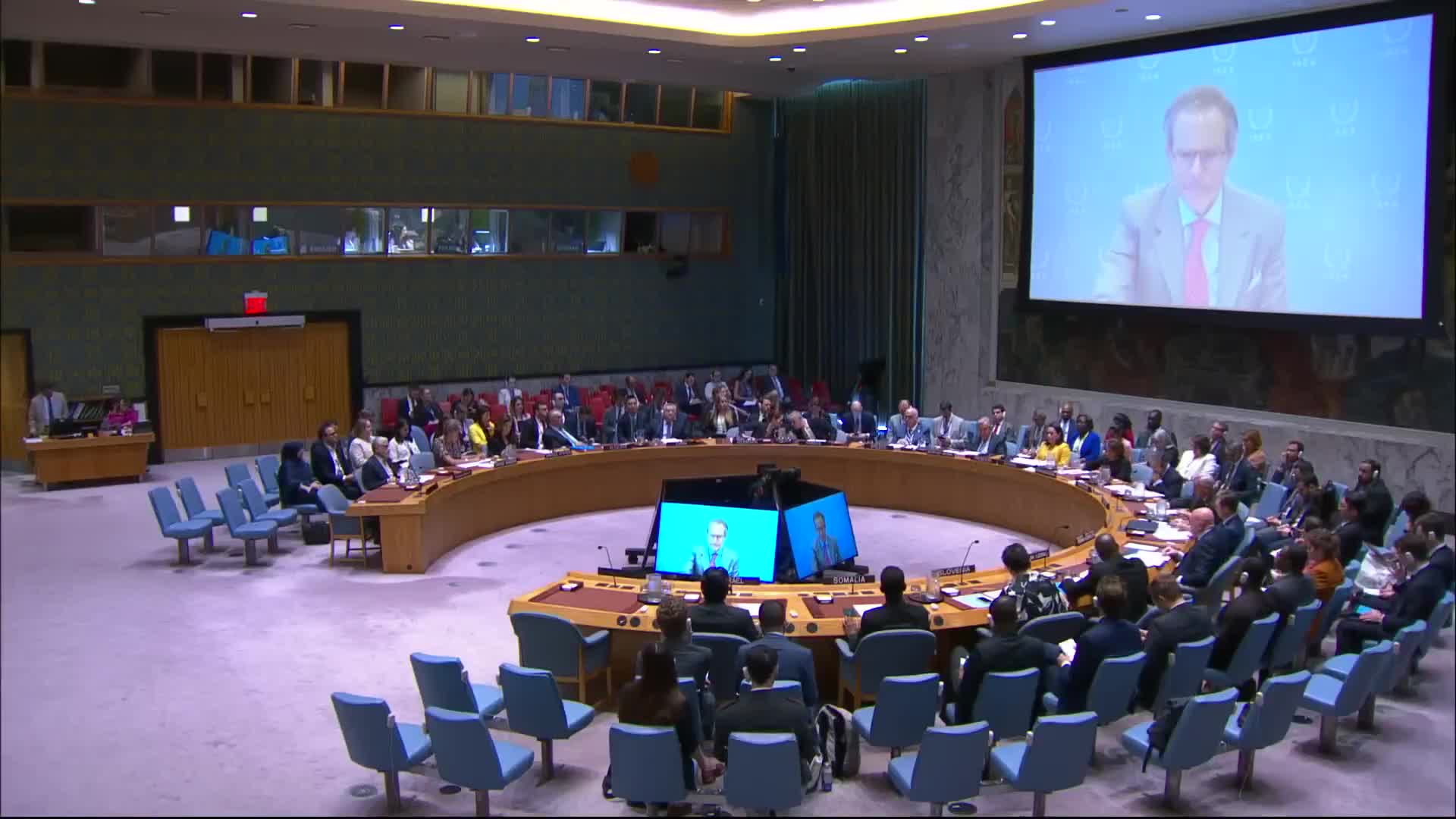
Summary
Rafael Mariano Grossi, director general of the International Atomic Energy Agency, told the United Nations Security Council that attacks on nuclear sites in the Islamic Republic of Iran have caused “a sharp degradation in nuclear safety and security” and that the IAEA needs timely access and technical information to verify safeguarded nuclear material.
Rafael Mariano Grossi, director general of the International Atomic Energy Agency, told the United Nations Security Council that attacks on nuclear sites in the Islamic Republic of Iran have caused “a sharp degradation in nuclear safety and security” and that the IAEA needs timely access and technical information to verify safeguarded nuclear material.
Grossi said the IAEA has been monitoring Iran’s nuclear sites closely since attacks began on June 13 and that, while the strikes “have not so far led to a radiological release affecting the public,” there is a risk this could change. He said the agency can “respond to any nuclear or radiological emergency” and urged “maximum restraint.”
The IAEA briefing described damage at multiple facilities. Grossi said the Natanz enrichment site contains two facilities: the main fuel-enrichment plant, where an electrical substation and other power infrastructure were destroyed and the main cascade hall appears to have been struck with ground-penetrating munitions; and a pilot enrichment plant whose above-ground portion was “functionally destroyed” and whose underground cascade halls were “seriously damaged.” He said radiation levels outside Natanz remained at normal background levels but that there is evidence of radiological and chemical contamination inside the site.
At the Fordow facility Grossi said the agency was not aware of any damage. At the Isfahan complex (referred to in the briefing as Esfahan), he said four buildings were damaged, including the central chemical laboratory, a uranium-conversion plant, a reactor fuel-manufacturing plant and an enriched-uranium metal processing facility that was under construction. He said no increase in off-site radiation was reported there but that chemical toxicity was a concern.
Grossi described strikes on the Tehran Research Center and related workshops where centrifuge components and rotors were manufactured, saying several buildings were hit or destroyed. He said the heavy-water research reactor under construction and a nearby heavy-water production plant were struck on June 19 but that, because the reactor was not operational and contained no nuclear material, no radiological consequences were expected.
Grossi singled out the Bushehr nuclear power plant as the site where an attack could have the most serious consequences. He said Bushehr is an operating plant that contains “thousands of kilograms of nuclear material.” He warned that a direct hit or damage disabling the two lines that supply electrical power to the plant “could cause its reactor core to melt,” with “a very high release of radioactivity to the environment” that might require evacuations, sheltering, stable iodine distribution, wide-area radiation monitoring and food restrictions extending to distances of “a few to several hundred kilometers.”
Grossi also said any attack on the Tehran research reactor “could also have severe consequences potentially for large areas of the city of Tehran and its inhabitants,” and reiterated that the safety of IAEA inspectors is “of utmost importance.” He said the host country has a responsibility to ensure their security and communications with IAEA headquarters.
The director general told the council the agency has verified that Iran’s uranium stockpiles remain under safeguards based on recent inspections and reporting to the IAEA Board of Governors, and he urged inspectors be allowed to verify that material—specifically the more than 400 kilograms of uranium enriched up to 60 percent U-235—remains accounted for. He said attacks on facilities would make verification more difficult.
Grossi said the IAEA stands ready to deploy nuclear safety, security and safeguards experts in Iran “immediately” where necessary, and asked council members to support a constructive, professional dialogue and to ensure the IAEA receives timely, regular technical information about affected facilities. He noted the IAEA incident and emergency centre has been operating 24/7 since the start of the conflict and cited prior IAEA statements that “armed attacks on nuclear facilities should never take place.”
Grossi closed by saying a diplomatic solution remains possible if there is political will and that the IAEA can provide a “watertight inspection system” to assure the peaceful nature of nuclear activities.
No formal Security Council decision, vote or directive on IAEA access or on Iranian facilities was recorded in the briefing transcript.