Get Full Government Meeting Transcripts, Videos, & Alerts Forever!
Get email alerts on the Transportation And Infrastructure topic
No spam. Unsubscribe anytime.
Council approves one EV patrol vehicle purchase; staff presents updated Fleet Electrification Study and highlights infrastructure costs
Summary
Glendale approved a single-source purchase of one upfitted Tesla Model Y patrol vehicle for field testing and received an updated fleet-electrification study from consultants, who said charger counts were reduced by usage optimization but that utility upgrades and total transition costs remain significant.
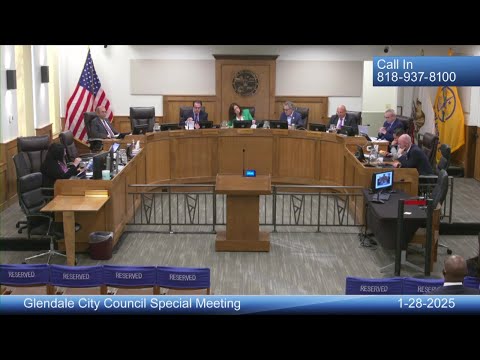
The Glendale City Council on Jan. 28 approved two related items: a staff request to procure a single upfitted electric patrol vehicle for the Glendale Police Department and a staff presentation of an updated Fleet Electrification Study by consultants from the Center for Transportation and the Environment (CTE). The procurement resolution passed on roll call after discussion (four yes, one no); council later voted to note and file the consultant study (three yes, one no, one abstain).
Single-source procurement and appropriation
Public Works staff said the proposed purchase is part of the city’s Fleet Electrification Plan and that Unplugged Performance Inc. is the sole authorized vendor to upfit Tesla vehicles. Staff reported receiving a vendor quote for a fully upfitted Tesla Model Y; the staff presentation cited a figure of $416,144 for a fully upfitted unit. Staff said the purchase is to test an EV patrol vehicle’s performance before the city considers broader fleet transitions. The council approved the single-source procurement and appropriation on roll call (Councilmember Brotman, Councilmember Kosakian, Councilmember Najarian and Mayor Asadjarian voted yes; Councilmember Garpetian voted no).
Council members probed differences in upfront costs versus hybrid alternatives, charging logistics and operational suitability for 24/7 police use. Fleet staff said an estimate for a similarly upfitted Explorer (internal-combustion baseline) is roughly $90,000, and that the procurement is intended as a one-off test to evaluate performance, maintenance and infrastructure needs before any broader transition.
Public comment raised concerns about cost and charging downtime. A caller said the Model Y shown in materials cost $127,000 (different from staff’s $416,144 figure), and urged caution; another caller said charging could leave a patrol vehicle unavailable for hours during a shift. Staff and fleet supervisors noted charging infrastructure at the police station and limitations on fast chargers and said they would evaluate operational implications in the field test.
Fleet Electrification Study update (consultant presentation)
Consultants Leslie Udi and Steve Claremont (Center for Transportation and the Environment) delivered an update to a 2022 electrification study. The update used recent vehicle-usage data, refined fleet categories, and incorporated state regulatory changes (the California Air Resources Board Advanced Clean Fleet regulation). Key consultant points:
- The EV market has matured with more models available for many light-duty vehicles, though medium- and heavy-duty EV options remain more expensive and have longer lead times. - The consultants optimized charger provisioning using vehicle-usage profiles; that optimization reduced the city’s required charger count in the study from roughly 868 to 351 chargers, which lowered the estimated infrastructure cost in the analysis (CTE figures). - Glendale Water & Power (GWP) upgrades to support vehicle charging increased in the consultant’s updated estimate (CTE reported GWP’s revised upgrade estimate increased from about $2.19 million in the prior assessment to roughly $3.25 million). CTE said high-level infrastructure costs remain material and warrant phased implementation and demand-management strategies. - Overall cumulative transition costs in the updated analysis were lower than the 2022 estimate when normalized in certain ways, but the consultants still projected a substantial cost to transition the municipal fleet over the multi-decade timeframe. The update included potential strategies to reduce utility costs (charge-management systems, staged charger activation, time-of-use rates, solar or battery storage) and flagged grant programs that the city could pursue.
Council reaction and next steps
Councilmembers expressed a range of views. Some supported the single test vehicle as a prudent step to evaluate real-world performance; others said the test vote felt premature given the limited availability of pursuit-rated EVs and unanswered questions about charger capacity, emergency response suitability, replacement-cycle costs and the potential for costs to be absorbed in departmental rates. Fleet staff and consultants said the purchase is a field test and that the study recommends delaying broad transition of emergency vehicles until technology and market options mature (the consultant recommended deferring full emergency-vehicle transitions until around 2030 for greater market readiness). The council voted to note and file the consultant study and asked staff to return with follow-up information and responses to specific questions about lifecycle costs, battery replacement expectations, charger-management options, and how departmental fleet rates would be impacted.
Votes at a glance
- Tesla Model Y upfitted patrol vehicle (single-source procurement and appropriation): outcome approved (Yes: Brotman, Kosakian, Najarian, Mayor Asadjarian; No: Garpetian). The procurement is a one-off test; staff to report back on operational results. - Fleet Electrification Study update: motion to note and file approved (Yes: Brotman, Kasakhian, Mayor Asadjarian; No: Garpetian; Abstain: Najarian).
Staff and consultants were asked to prepare additional briefings that address operational readiness for emergency vehicles, clarify cost estimates and grant opportunities, explain GWP upgrade timing and costs, and model how fleet-cost changes would flow into departmental rates and potentially into user or utility rates.