Get Full Government Meeting Transcripts, Videos, & Alerts Forever!
Get email alerts on the School Budgeting topic
No spam. Unsubscribe anytime.
Timberlane Budget Committee adopts FY2026 budget after debate over $2.4 million in potential cuts
Summary
After hours of discussion about potential reductions to staffing, capital projects and program lines, the Timberlane Regional School District Budget Committee voted to send a proposed FY2026 budget to voters following a split vote and subsequent motion to adopt a revised figure.
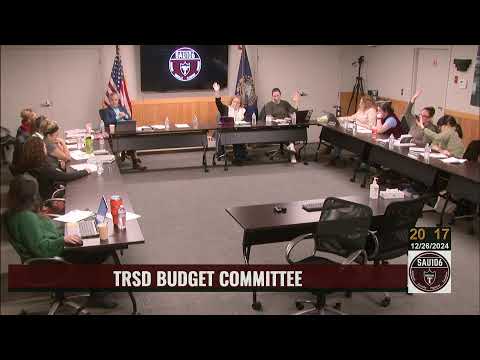
The Timberlane Regional School District Budget Committee voted Dec. 26 to forward a proposed fiscal year 2026 budget for the district to the voters after extended debate over whether to implement roughly $2.4 million in additional reductions.
The committee, meeting Dec. 26, considered a set of 18 reduction items grouped into assumptions, capital-improvement (CIP) changes and personnel reductions. After discussion and two formal roll-call attempts, the committee approved a motion to accept the proposed FY2026 budget and send it to deliberative session. The committee’s final recorded majority vote in favor was five members; one earlier motion to adopt a version of the budget failed on a 4–5 vote before members reconvened and passed an amended motion.
The debate centered on a mix of smaller, low-risk adjustments and larger, more consequential options. Administrators presented a “pathways” table totaling multiple options that could be combined to reach a $2,400,000 reduction target the committee asked for at an earlier meeting. Business administrator Justin (identified in the meeting as the district’s business administrator) told the committee that the 18 items could be flexibly grouped and that “these are not my recommendations to you,” emphasizing that administration would provide impact statements if the committee requested specific changes.
Administrators highlighted several assumptions that together would account for several hundred thousand dollars in savings: assuming a lower group medical rate for some employees (about $346,165), reducing the retirement-incentive assumption ($275,000), lowering anticipated food-service expenses ($112,000) and recognizing a locked transportation contract renegotiation (roughly $95,867–$100,000). The packet also listed roughly $144,000 of academic resources reductions and a variety of smaller reductions in academic equipment and professional development.
Capital projects were a focal point. The CIP line in the draft budget was shown at about $1.8 million for a set of projects that included high-school bathroom renovations (budgeted at roughly $500,000 for the first phase), a campus fence ($200,000) and roof work at Danville (about $550,000). Administrators said some CIP projects could be deferred and that there was a potential $2 million lease-related funding source the school board could consider using; the school board — not the budget committee — would decide which projects to advance if CIP dollars were reduced.
Personnel options drew the strongest objections. Administrators outlined staffing scenarios ranging from repurposing the last 11 new positions to cuts of 16 or 29 certified positions, and up to 43 paraeducator positions; reductions to school-based administrative staff were also shown in gradations (for example, removing 5 school admin positions or more). Justin stressed that many of those positions are filled now and warned that cutting contractually obligated items or benefits carries risk because the district remains obligated if employees exercise benefits (for example, retirement payouts or contractual personal-day buyouts).
Public commenters and committee members repeatedly framed the choices as tradeoffs between tax relief and services. Community member Mr. Sapia, who addressed the committee during public comment, urged long-term investment in the district and criticized past decisions that, he said, “threw away tons of revenue because they didn't wanna make the upfront investment in things.” Committee member Sue Sherman said during the meeting, “I personally, I cannot vote for these cuts,” reflecting concern that proposed personnel reductions would reduce services below desirable levels.
Committee members pursued a compromise that removed the CIP decrease from the reduction column but retained several of the smaller assumption-based reductions. At one point the committee focused on a package that: kept transportation savings and several smaller assumptions, reduced district professional development from about $70,850 to $50,000, and left the CIP line in the budget (i.e., did not cut the CIP figure). The iteration the committee settled on produced roughly a $1,000,105,587 reduction off the original asked figure in the discussion grid (committee math was iterative during the meeting and members requested that staff tabulate running totals).
Votes and procedure: the meeting recorded two separate votes on versions of the proposed FY2026 budget. An initial motion to adopt a version of the budget failed on a 4–5 vote. After further discussion and reworking of lines (notably removing a CIP cut and adjusting the professional-development line), the committee approved a subsequent motion to accept the proposed FY2026 budget and forward it to deliberative session; the successful motion was recorded as passing on a 5‑vote majority. The committee also voted earlier in the meeting to accept the Dec. 16 minutes (8 in favor, 1 abstention).
Administrators reminded the committee that some items presented as reductions were assumptions rather than guaranteed savings. Justin cautioned that if employees choose higher-cost health plans or if a larger-than-expected number of employees retire and trigger incentive payouts, the district would remain contractually obligated and the board would have to find the funding elsewhere. Justin also reviewed the district’s process: the administrative team and principals met to produce options, and the school board — which controls capital decisions and final allocations — would ultimately decide any CIP reallocation.
Next steps and public engagement: administrators announced statutory public hearings for the citizen petition tied to a proposed 2½ percent tax cap. The hearings were scheduled for: Feb. 11 at Danville School (7 p.m.), Feb. 13 at Atkinson Academy (7 p.m.), Feb. 18 at Sandown North (7 p.m.), and Feb. 20 at the PAC in Plaistow (7 p.m.). Committee members also discussed sequencing for the fiscal 2027 process so the committee, administration and school board have clearer timelines for deliberations.
The committee did not adopt specific line-item personnel cuts during the vote; the action approved at the Dec. 26 meeting forwarded the proposed FY2026 budget with the committee’s selected adjustments to the district’s deliberative session and ultimately to the voters. The school board retains authority over capital-project prioritization and the district remains contractually bound where collective bargaining agreements apply.
For the record: multiple committee members and administrators repeatedly emphasized uncertainties and risks tied to the administrative assumptions, and several members urged preserving positions and core services even while seeking tax relief. The deliberative session and upcoming public hearings will be the next opportunities for town officials and residents to question and weigh the budget that the committee forwarded.