Get Full Government Meeting Transcripts, Videos, & Alerts Forever!
Get email alerts on the Flood Risk Disclosure topic
No spam. Unsubscribe anytime.
Maine enacts LD 2035 requiring flood-risk disclosures in real estate transactions
Summary
A 2024 Maine law, LD 2035, requires sellers to disclose digitally mapped FEMA special flood hazard area status and recent flood history; the Department of Agriculture, Conservation and Forestry described the law and implementation guidance during a regional workshop.
David Ludwig, Senior Planner at the Department of Agriculture, Conservation and Forestry, described LD 2035 and the department’s approach to implementing the law at a Midcoast hazard-resilience workshop. "LD 2035...became law effective on August 9, 2024," Ludwig said, and it amends existing disclosure requirements for commercial and noncommercial real estate transactions to include whether a structure is located in a digitally mapped Federal Emergency Management Agency (FEMA) special flood hazard area and whether the property experienced floods, flood damage, flood insurance claims, or flood-related disaster aid while the current seller owned it.
Ludwig said the department drafted the bill as a department-sponsored measure and sought examples from other states and federal guidance to shape Maine’s approach. He said the department aimed to balance consumer protection, privacy and ease of compliance by working within existing disclosure frameworks rather than creating an entirely new statutory regime. "We tried to strike a balance between consumer protection, privacy, and ease of compliance," Ludwig said.
The department used resources such as FEMA maps and comparative analyses from the Natural Resources Defense Council to identify elements that would work in Maine. Ludwig said the department has been conducting outreach to the real estate community and other state agencies that will be affected by the law, to aid understanding and compliance. He also said the department considered but did not adopt some stricter disclosure measures in order to keep the statute implementable.
Ludwig offered practical advice for municipalities and practitioners: adapt tested approaches from other jurisdictions, involve relevant municipal departments early in the drafting process, and consider incremental changes if sweeping revisions are not feasible. "Don't let the perfect be the enemy of the good," he said.
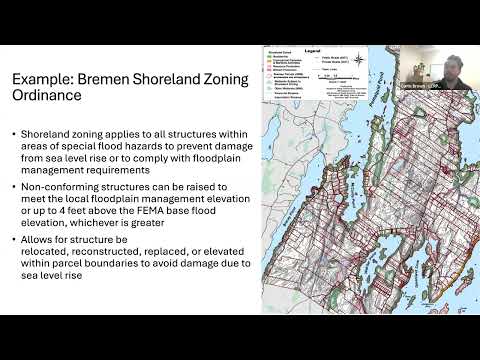
The presentation did not announce any enforcement changes beyond the statutory disclosure additions; Ludwig described outreach and technical support from the department as the primary early implementation steps. The workshop materials included a map showing digital FEMA special flood hazard areas and a national comparison of state disclosure regimes used in the statute’s drafting.
Ending: The department director closed its segment by reiterating that communities can learn from other states’ models and from federal guidance when updating local ordinances or drafting complementary rules to reflect the new disclosure requirements.