Get Full Government Meeting Transcripts, Videos, & Alerts Forever!
Get email alerts on the Street Vending topic
No spam. Unsubscribe anytime.
Ordinance committee forwards draft vehicle-vending rules to City Council after weeks of outreach
Summary
Santa BarbaraCityOrdinance Committee voted unanimously to send a proposed ordinance regulating vending from vehicles to the City Council with staff direction to incorporate committee feedback on safety, lighting, noise and designated locations.
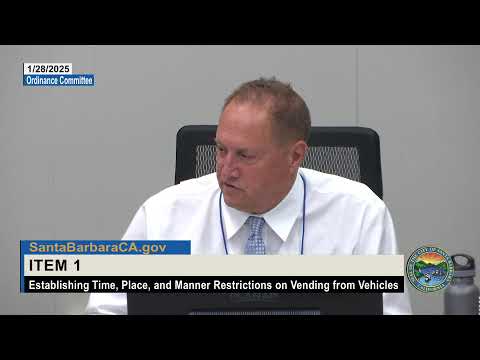
The Santa Barbara City Ordinance Committee voted unanimously Jan. 28 to forward a draft ordinance that would regulate vending from vehicles 9.48.010to the City Council, after hearing staff presentations, public comment and questions about enforcement, lighting, noise and geographic restrictions.
City Attorney John Domas briefed the committee on distinctions between sidewalk vending and vending from vehicles, saying the city already regulates sidewalk vending under chapter 9.49 but must treat vehicle vending differently because courts and the vehicle code limit blanket bans. "We currently have a sidewalk vending ordinance under chapter 9.49, and that is different or distinct in some ways when you compare it to vending from a vehicle in the street," Domas said, adding that the law allows more regulatory tools for vehicle vending because of health and safety concerns.
The proposed rules would allow vending from vehicles but add time, place and manner restrictions aimed at public safety. Key provisions described by staff include a 7 a.m. start and a 10 p.m. end to permitted vending hours; a four-hour maximum continuous vending period followed by a required move of at least 500 feet; a requirement that the vehicle be fully parked before any sale; sales windows be on the sidewalk side of the vehicle; display of health permits and compliance with state requirements for hand-washing and restrooms; and a ban on on-board diesel or gasoline generators for environmental reasons.
Barbara Anderson, City Administrator, said staff met with about a dozen mobile food-truck operators and the Downtown Santa Barbara Association while drafting the ordinance. "We have been working with about a dozen to 13 mobile food truck operators since last summer," Anderson said. She told the committee operators asked for clearer guidance on where they may operate lawfully in the city and that staff circulated the draft and followed up individually with operators.
Police Chief Gordon told the committee the department receives noise complaints about mobile vendors and supported the 10 p.m. cutoff as aligned with the city's noise ordinance. "We also get a lot of noise complaints after hours related to permitted mobile food vendors," he said, citing music and other post‑closing activity as common sources of complaints.
Staff also proposed full prohibitions on vending on certain high-traffic or narrow streets, because of safety and congestion risks; during the presentation staff listed the affected area as "within the area bounded by and including Chapala Street, Mitchell Traina Street, and Anacapa and Cabrillo," and called out segments of Milpas and San Andres Streets. The committee asked staff to clarify and more precisely define those boundaries before Council review.
Public commenters included Noel Vargas of El Pastor Sito Food Truck, who asked for clearer guidance and outreach materials for operators and suggested allowing temporary exemptions from the four-hour parking limit at designated high-foot-traffic locations. An online commenter who identified herself as a Milpas Street business owner urged staff to study alternatives to locating vendors on Milpas and suggested central lots or beach lots be used instead so operations can be monitored and managed.
Committee members pressed staff on several operational questions: whether current oversized-vehicle rules would block many existing trucks, how enforcement would distinguish permitted and unpermitted vendors, how to prevent clusters of trucks from occupying a single block, whether lighting and flashing signs would be restricted, and whether fire-safety rules for mobile kitchens were sufficient. Staff said vehicle vending would remain subject to the city's oversized-vehicle and parking regulations and to applicable fire and health codes, and that some clarifications and additional definitions (for example, "adjacent" to parks or schools and a prohibition on flashing lights) could be added before Council consideration.
Committee member Jordan called for more pathways that allow trucks to operate where customers gather and proposed evaluating designated, pre-vetted curb or lot locations that could be permitted for vending. Committee member Berg Gutierrez questioned limiting hours to 7 a.m. to 10 p.m., arguing that some workers need food before early shifts, and said the city should prioritize enforcement against unpermitted vendors rather than imposing rules that constrain permitted operators.
After discussion, Committee member Jordan moved and Committee member Gutierrez seconded a motion to forward the draft ordinance to the City Council with the committee's feedback and with staff direction to continue community outreach and to incorporate the clarifications discussed. The committee voted aye unanimously (Jordan, Gutierrez, Chair Sneddon). The staff presentation indicated the ordinance would return to Council in the coming weeks.
The draft ordinance would give the city new administrative and criminal enforcement options specific to vehicle vending; staff emphasized courts expect time, place and manner restrictions to be narrowly tailored and tied to health and safety reasons rather than primarily economic protection for brick-and-mortar businesses.
Next steps: staff will refine the draft to clarify boundary definitions, add prohibitions for flashing or distracting lighting, more explicitly reference applicable fire-safety and health-code requirements, and present the revised ordinance to the full City Council for policy discussion and possible adoption.