Get Full Government Meeting Transcripts, Videos, & Alerts Forever!
Get email alerts on the Street Vending topic
No spam. Unsubscribe anytime.
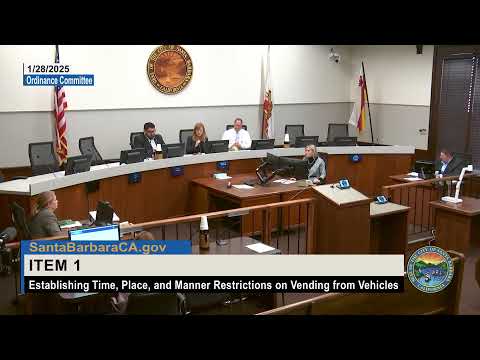
Santa Barbara committee sends draft street‑vending rules to City Council after public comment and changes
Summary
The Santa Barbara Ordinance Committee voted to forward a draft ordinance regulating sales from vehicles and street vending to the City Council, asking staff to add clarifications on lighting, fire-safety, definitions and possible designated curb spaces after public testimony from operators and business owners.
The Santa Barbara City Ordinance Committee voted to send a draft ordinance regulating sales from vehicles and street vending to the full City Council after a discussion that included staff presentations, public comment and questions from committee members.
The ordinance draft would create a citywide regulatory framework for sales conducted from vehicles and on public streets, establishing time limits, siting rules and operational requirements aimed at addressing health-and-safety, traffic and neighborhood impacts. Committee members asked staff to add clarifications on lighting and strobe-sign rules, fire‑safety measures, the meaning of “adjacent” to parks and schools, and the possibility of designated curb or lot locations for food trucks before the Council considers the item.
City staff summarized the draft ordinance as centered on health-and-safety principles. Proposed provisions discussed by staff and committee members include a sales window limited to 7 a.m. to 10 p.m.; a four‑hour maximum continuous vending period with a requirement that vendors relocate at least 500 feet after that period; prohibition of vending adjacent to schools during school session; a ban on sales in city‑maintained parks and beaches; a requirement that any vehicle be fully parked before a sale; sidewalk‑side service windows only; visible public‑health permits for food sales; and discouragement of diesel generators for environmental reasons. Staff said vendors must comply with all parking and traffic laws and that enforcement could include administrative remedies and misdemeanor penalties depending on the violation.
Staff told the committee it had conducted outreach over the past year with roughly a dozen to 13 mobile food‑truck operators, distributed the draft ordinance and met with the Downtown Santa Barbara Association for feedback. Operators and business owners who spoke during the meeting raised several recurring issues: the economic need for accessible locations with pedestrian traffic, the effect of any geographic exclusions on pushing trucks into residential side streets, lighting and strobe‑light impacts on neighbors and drivers, and uncertainty about how the city’s existing “large vehicle” rules would apply to typical food trucks.
Noah Vargas, who identified himself as affiliated with a mobile food‑truck business, asked for clearer rules to avoid conflicts with adjacent property owners, suggested the city produce an informational brochure for operators, and said many trucks the city sees are about 25 feet long. Natalia Goboni, describing herself as a local street‑business owner, urged the city to study concentrated, monitored lots as an alternative to curbside vending and said she worried about bright lights and late operating hours.
Committee members asked staff to return to the Council with additional clarifications, specifically: define “adjacent” in relation to parks and schools; add a prohibition on flashing or strobe signage that could distract drivers; include explicit cross‑references to the California Fire Code and local fire‑safety inspection requirements for cooking equipment on vehicles; clarify how the city’s large‑vehicle/parking regulations intersect with the proposed vending rules; and study whether designated curb or lot locations could provide safe, monitored sites that concentrate activity without pushing trucks into narrow residential cross streets.
Committee chair President Snedon, Councilmember Jordan and Councilmember Gutiérrez led the discussion. Jordan said the city should “offer certainty” about allowed locations while also creating more opportunities for legitimate operators; Gutiérrez and other committee members pressed staff on enforcement tools and the impact of restrictions on existing mobile operators. Staff said detailed enforcement data are limited because the city currently lacks a permitting system for vending from vehicles and therefore has not been able to comprehensively measure the size and configuration of trucks operating in public rights‑of‑way.
Following that discussion, Councilmember Jordan moved to forward the draft with the committee’s requested clarifications to the City Council for further consideration; the motion was seconded by Councilmember Gutiérrez and approved on a verbal vote. Staff said they will continue outreach with operators and stakeholders and will present the revised draft to the Council in the coming weeks.
Background: the discussion separated vending from other street‑sale regulations (such as transient vendors and sidewalk retail), and staff noted that many operational and safety requirements (noise decibel thresholds, fire‑safety codes, health permits) already exist in other parts of the municipal code and state codes and will be applied to mobile food vendors as appropriate.
The committee’s vote does not adopt the ordinance; it forwards the draft and the committee’s requested changes to the full City Council for formal consideration and any final action.