Get Full Government Meeting Transcripts, Videos, & Alerts Forever!
Get email alerts on the Police Metrics Narcan Coresponse topic
No spam. Unsubscribe anytime.
Police present Q4 mission strategies: upticks in traffic enforcement, Narcan deployments and co-response activity
Summary
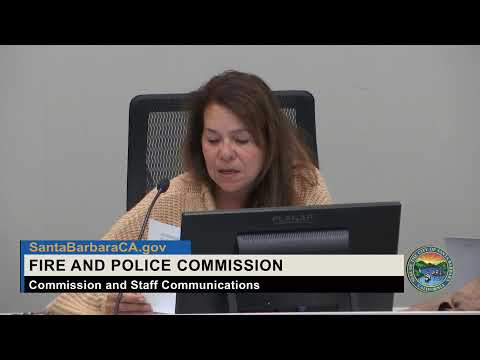
Santa Barbara Police presented Q4 2024 metrics Jan. 23 showing small increases in misdemeanor and felony arrests, higher traffic stops, 33 Narcan deployments, expanded co-response follow-ups and a new community engagement coordinator post.
Commander Charlie Kitsapas of the Santa Barbara Police Department briefed the Fire and Police Commission Jan. 23 on the department's Q4 2024 mission-strategy metrics, reporting modest increases in arrests and traffic enforcement along with growth in crisis co-response and outreach efforts.
Kitsapas described the department's four mission-strategy categories: reducing harm; relationship building and quality of life; felt presence; and service. Comparing Q4 2023 to Q4 2024, Kitsapas reported misdemeanor arrests up 5%, felony arrests up 6% and traffic stops up 8, totaling about 1,000 traffic stops for the quarter.
Kitsapas highlighted 33 Narcan deployments in the quarter, calling the number "really significant" and noting its potential lifesaving role. He also described the co-response program, which pairs a specially trained officer with a behavioral-health clinician; the department reported 55 co-response mental-health follow-ups during the quarter.
The department launched a full-time community engagement coordinator position in late October; Kitsapas said Samantha Acosta now fills that role, which the department expects to use to continue and expand outreach work.
Kitsapas reviewed response-time goals and results: priority-1 response goal is seven minutes (achieved at 5.7 minutes), priority-2 goal is 14.5 minutes (met at 14.5 minutes), priority-3 goal is 30 minutes (exceeded at 43.5 minutes), and priority-4 goal is 50 minutes (exceeded at 57.6 minutes). He noted a 10% increase in calls for service compared with the prior year, equivalent to roughly 800 additional calls for the quarter and a likely factor behind increased activity.
Commissioners asked about drivers for the arrest increases and the trend in Narcan deployments; Kitsapas said some increases can reflect more proactive policing, probation/parole holds, and simply higher call volume, and that Narcan deployments have generally ranged between about 20 and 40 per quarter.
The presentation was informational; no formal action was recorded on the mission strategies report.