Get Full Government Meeting Transcripts, Videos, & Alerts Forever!
Get email alerts on the Public Housing Annual Plan topic
No spam. Unsubscribe anytime.
Charlottesville housing authority approves submission of FY 2025–26 annual plan
Summary
The Charlottesville Redevelopment and Housing Authority voted to submit its fiscal year 2025–26 annual plan after a presentation on outreach, translations and redevelopment impacts, including a reduced number of public housing units and an upcoming review of eviction policies.
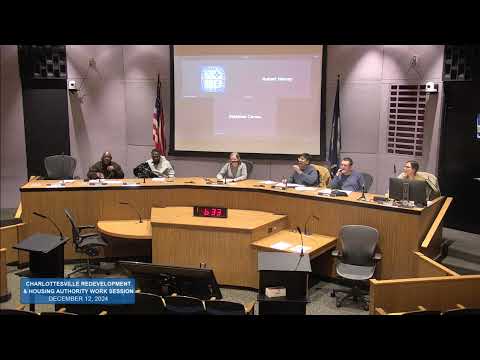
The Charlottesville Redevelopment and Housing Authority on Monday voted to approve a resolution to submit its fiscal year 2025–26 annual plan, which covers April 1, 2025, through March 31, 2026. The board approved the resolution by voice vote after a presentation from staff and comments from resident leaders.
CRHA staff member Glenn Matthews presented the plan’s timeline, outreach and key changes. Matthews said the official draft was posted Oct. 28 and that the authority expanded outreach this year by posting paper notices, sending rent-statement flyers, using social media and, for the first time, providing the document in Arabic. “It was posted in the newspaper, on paper, in rent statements, on social media, on Facebook, and Instagram,” Matthews said.
Latricia, executive director of the public housing association of residents known as FAR, spoke during the meeting’s public-comment segment and urged continued partnership and resident involvement. “At the heart of this relationship, it is about the partnership, accountability, and trust,” Latricia said, describing the Resident Advisory Board as “a vital part” of shaping CRHA’s annual plan.
The discussion summarized several substantive issues contained in the annual plan and the housing authority’s formal response to FAR’s wrap comments. CRHA staff reported a reduction in the total number of families served compared with last year, which staff attributed in part to increased housing assistance payments tied to redevelopment and a resulting shortfall in the voucher program that has limited leasing to families on the wait list.
Staff explained the difference between Section 8 and Section 9 subsidies: Section 8 covers voucher programs, including project-based vouchers assigned to specific units, while Section 9 refers to public-housing subsidy for authority-owned units. CRHA staff noted the authority currently has fewer public-housing units than its Faircloth limit; the transcript records a Faircloth figure of 376 and a current figure discussed as 326. Staff said some Faircloth-eligible units remain “in a bank” to be used if financing allows.
On redevelopment, staff said replacements of traditional public housing are difficult because Section 9 subsidy levels are lower than alternatives, and that CRHA remains committed to preserving public housing where feasible. Staff noted that resident planners reduced the number of proposed units in phase 2 of the 6th Street redevelopment and that CRHA now anticipates a total of about 80 to 90 units on that site when the project is complete.
CRHA also said it will review and analyze its eviction process in light of federal guidance and planned federal notices. The authority expects new Public and Indian Housing (PIH) notices and to follow HOTMA (Housing Opportunity Through Modernization Act) updates; staff said they will work with FAR and legal partners to limit negative impacts on residents. CRHA indicated a January work session to discuss eviction procedures and related recommendations from FAR.
On administrative steps, staff said HUD’s portal required a shorter submission form this year, so CRHA will submit the HUD portal form and also email a more comprehensive copy that includes minutes, translated flyers and the authority’s response to FAR’s wrap comments. City staff reviewed the plan for consistency with the consolidated plan; Deputy City Manager James Reese agreed to sign certifications where the city manager was unavailable.
A board member moved and another seconded a resolution “approving the submission of the Charlottesville Redevelopment and Housing Authority's proposed annual plan for fiscal year 25–26.” The board approved the motion by voice vote. The public record shows affirmative responses in open voice (“Aye. Aye. Yes.”); no opposing votes were recorded in the transcript.
The authority will attach the public-hearing minutes, translated materials, FAR wrap comments and the housing authority’s written response to the version submitted to HUD and keep stakeholders informed of follow-up work sessions and policy changes.
Why this matters: The annual plan frames CRHA’s programs, redevelopment strategy and tenant protections for the coming year. Changes to subsidy mixes, redevelopment pro formas and federal guidance can affect how many deeply affordable units remain in authority control, how displaced residents are rehoused and how eviction processes are applied. The authority said it will continue working with FAR, Legal Aid and resident planners as those issues are further developed.
Ending: The board closed the meeting after the vote and indicated staff will circulate the finalized documents for signatures and HUD submission. CRHA staff said they will return to the board and to FAR with updates, including a planned January session on eviction policy.