
Pickens council hears attorney briefing on Greenville Water supply agreement as residents press for transparency
Get AI-powered insights, summaries, and transcripts
Subscribe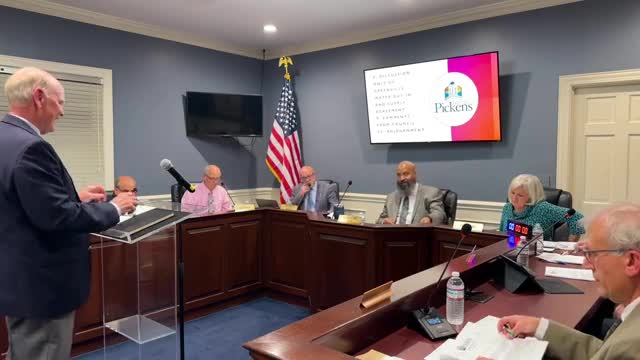
Summary
Council received a legal briefing and extensive public comment on a proposed long-term supply agreement with Greenville Water. Attorneys described a negotiated 40-year supply contract with optional renewals; residents and councilmembers asked for more financial detail and an exit timetable tied to the Pickens Joint Regional project.
Pickens City Council members spent the meeting hearing public comment and a legal briefing on a proposed water-supply arrangement with Greenville Water, as residents urged greater transparency about the city’s decision to withdraw from Pickens Regional Joint Water.
The matter drew prolonged discussion after residents said they had learned about the withdrawal informally and sought detailed comparisons between Greenville Water and Pickens Regional Joint Water. Pam Winters, a resident, told the council: "This research and well thought out decision making process was never done publicly." Several other residents repeated requests that detailed financial analyses and contract terms be made available for review.
The council then heard from Alec Evans, an outside water-systems attorney with Parker Poe, who reviewed the draft supply agreement and described key legal features. "Agreements, in South Carolina can be as long as 40 years," Evans said, and explained the contract the city and Greenville negotiated would have a 40-year initial term with the possibility of two 30-year renewals. He said the deal is a finished-water supply agreement and that Greenville Water’s rates are structured in part to recover capital costs over time.
Why it matters: the choice of a long-term water supplier affects rates, capital exposure and which infrastructure projects the city will support. Several speakers warned the council that the decision would have financial consequences for decades and asked the council not to finalize commitments without making financial comparisons public.
Key details from the meeting
- Contract term and renewals: Evans said the negotiated supply agreement is a 40-year contract and may be renewed for two 30-year terms if both parties agree. The city asked for an explicit exit provision tied to completion of the Pickens Joint Regional plant schedule; Evans said he included a January 2026 milestone in a draft exit-related clause requested by the city but noted engineering schedules discussed by Rosier Engineering suggest completion around late 2026 and might realistically be 2027.
- Buy-in versus wholesale pricing: Council members and residents pressed on the difference between buying capacity (a "buy-in") and taking wholesale service. The attorney and city staff described the buy-in model as one that reduces per-unit cost because the buyer shares in capital costs; meeting discussion cited examples in the draft that priced buy-in capacity at roughly $0.66 per 1,000 gallons versus retail/wholesale rates that can exceed $2 per 1,000 gallons depending on the account and meter class. The transcript included an example figure of an initial buy-in amount of about $3,800,000 and a 3% carry charge associated with that initial buy-in; council asked staff for a spreadsheet showing how those numbers produce the per-1,000-gallon charges.
- MOU and timing: The memorandum of understanding between Pickens and Greenville was noted as time-limited. Council members and the city attorney said the city’s MOU protections will need to be extended while staff and outside counsel negotiate unresolved items; staff said an MOU in effect will allow more time for review through January but asked for additional time to complete analysis.
- Contract drafting issues: Council members asked the city attorney to check specific drafting items. One council member pointed out an arithmetical mistake in a capacity-calculation table (54,000,000 ÷ 1.15) and asked staff to confirm corrected figures. Evans said he had submitted markup questions to Greenville and that some requested clarifications and concessions had been accepted.
Council direction and next steps
Council did not vote on the Greenville Water agreement at the meeting. Instead members and staff agreed to gather more financial detail and to arrange follow-up negotiations with Greenville Water if the council requests direct involvement. Staff and outside counsel were asked to produce comparative spreadsheets, explain the buy-in/wholesale economics, and return with clarified contract language and corrected calculations. The city’s MOU remains in effect for the near term, giving time for council review.
Quotations from the record
- "This research and well thought out decision making process was never done publicly," — Pam Winters, resident, on public outreach and transparency.
- "Agreements, in South Carolina can be as long as 40 years," — Alec Evans, attorney, Parker Poe, summarizing the maximum initial term in South Carolina water agreements.
Context and background
Council members and multiple residents said tensions over the water decision grew after a resolution withdrawing from Pickens Regional and subsequent public discussion. Several residents urged the council to hold a fully public comparison of alternatives before taking final action. The legal briefing emphasized that long-term water-supply agreements are complex, involve capital-recovery mechanics and typically carry multi-decade terms.
What comes next
Council asked staff and outside counsel to return with: redlined contract language correcting numerical errors; a clear memo that explains the initial buy-in, the ongoing buy charge and per-1,000-gallon examples; and a proposed schedule for additional negotiations or public briefings before any final vote.