NOPD credits sustained partnerships for citywide crime drop, asks council to fund continued sustainment and recruiting
Summary
New Orleans Police Department Chief Anne Kirkpatrick told the Joint Criminal Justice and Budget Committee on Oct. 28 that violent crime is down roughly 26% year‑to‑date but said the department needs funding for recruitment, training and crime‑lab capacity to sustain the gains.
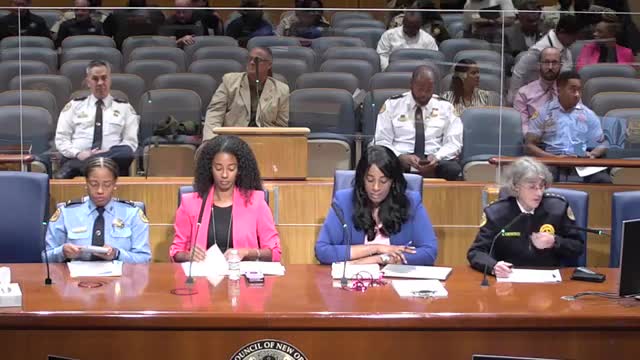
New Orleans Police Department Chief Anne Kirkpatrick told the City Council’s Joint Criminal Justice and Budget Committee on Oct. 28 that the department is seeing sustained reductions in violent crime but remains short‑staffed and needs funding to keep reforms in place. She said year‑to‑date violent crime is down roughly 26% and noted steep drops in auto theft and vehicle burglary.
The department credited a “Grip” strategy that includes the city’s NoDICE initiative and closer work with state and federal partners for much of the reduction. “The collaboration between the NOPD and the ATF, the NOPD and the FBI — that coordination is what helped us shutter… hubs of criminality,” Kirkpatrick said, citing joint enforcement that led to recent targeted closures.
Why it matters: Kirkpatrick said the progress could be reversed without continued investment. Her budget request for 2025 asks council to fund 991 commissioned positions and 327 civilian positions and to approve a $500,000 recruitment and retention marketing line aimed at growing application pools. She told the committee the department has been replacing aging equipment and is moving to sustain many consent‑decree reforms — a step that would lower monitoring costs once fully approved by the federal court.
What the department presented: Kirkpatrick outlined 2025 priorities that keep violent‑crime reduction first, while adding a renewed focus on drug enforcement, traffic enforcement and property crimes (including shoplifting). She described efforts to increase officer recruiting by expanding outreach beyond the city and to preserve hiring standards while enlarging applicant pools. She also described ongoing investment needs for technology such as body‑worn cameras, TASER replacements and e‑warrant software included in the department’s operating request.
Crime lab and DNA backlog: Chief Kirkpatrick was joined by Dr. Kelly, the police crime‑lab director, who reported the lab is in the validation phase for forensic biology and expects to add CODIS capability in 2026–27. Dr. Kelly said most lab positions are filled but noted the national DNA backlog has forced the Louisiana State Police to outsource tests — a costly and unsustainable workaround. District Attorney Jason Williams and Kirkpatrick both urged support for equipment and pay so the local lab can test more types of samples locally and reduce cost and turnaround time.
Recruitment and retention details: Lieutenant Nicole Powell, NOPD recruiting lead, told the committee the department ran four academy classes in 2024 and is holding two more; classes graduate relatively small cohorts and the department’s attrition means it is generally filling, not growing, overall headcount. Kirkpatrick said she will not lower hiring standards to fill seats; instead the department seeks more marketing and incentives to attract candidates. The department also requested funding for training (line item $100,000 in 2702) and for specific IT and camera upgrades necessary for sustained operations.
On mutual‑aid troops and legal agreements: Council members asked about Troop NOLA and memoranda governing state troopers’ operations in the city. Kirkpatrick said the relationship with Louisiana State Police has been “strong” and credited state support for adding enforcement capacity, but acknowledged legal and coordination questions — for example, whether a formal MOU is needed — remain and will be handled by city and state attorneys.
What’s next: The NOPD asked the council to consider the recruitment funding and to support items that will allow the department to move into a sustainment phase for its consent‑decree obligations. Kirkpatrick said sustained federal and community partnerships and continued investment in training, equipment and pay are essential to keep the recent crime‑reduction gains from backsliding.
Ending: The chief thanked councilmembers and reinforced that many gains come from coordinated work between police, prosecutors, the sheriff’s office and community groups — and urged the council to weigh those partnerships as it finalizes the 2025 budget.