
Neighbors urge action as feral cat colony fuels complaints; residents and advocates seek expanded TNR support
Get AI-powered insights, summaries, and transcripts
Subscribe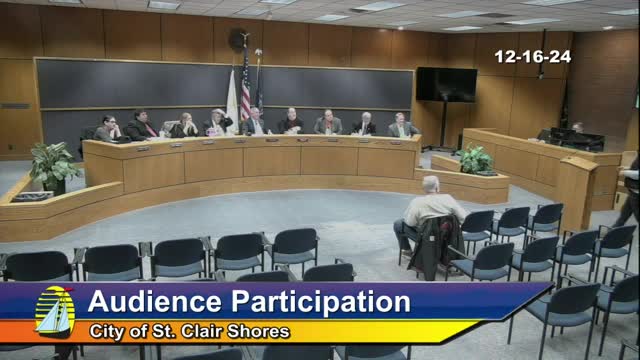
Summary
Several St. Clair Shores residents used the Dec. 16 meeting to press the City Council and staff for action after a large feral cat colony near a residential block led to persistent nuisance complaints and animal-welfare concerns.
Several St. Clair Shores residents used the Dec. 16 audience-participation period to press the City Council and staff for action after a long-running feral cat colony in a residential block intensified nuisance and animal-welfare problems.
Maria Martinez, who identified herself as a resident at 21001 East 11 Mile Road, described the neighborhood situation and urged the council to expand the city's Trap-Neuter-Return (TNR) program through the city's animal-welfare committee and partnerships with local rescue groups. Martinez said rescue groups are overwhelmed, described long scheduling backlogs for spay/neuter services and asked for a coordinated city-supported effort to trap, transport, sterilize and return community cats where appropriate.
“Some of the rescues are overwhelmed,” Martinez said, adding that there are “3 month backlogs” for spay/neuter services and that volunteers and funding are limited. She said citizen groups such as 4 Paws 1 Heart, All About Animals and regional partners have been involved but cannot handle large colonies without broader municipal coordination.
Residents who live near the colony described daily impacts. Molly Scanlon Donaldson, a newer resident who also works part time for the city, said the cat activity on her property is severe and that she has tried county and nonprofit channels without success. “Trap, neuter and release sounds like a beautiful, wonderful program, but I can speak as a neighbor, it does not work for me,” she said.
Gina Burris, whose family has lived on the block for decades, told the council she has to clean up animal waste daily and said a resident's colony has grown despite prior citations. She said animal-control partners told her they have issued citations but that county animal-control services will not continue to respond and have turned enforcement responsibilities to the city.
City staff responded that the city's animal-related ordinance provides for confiscation of unrestrained animals unless the property is part of a recognized trap-neuter-release program. A staff member said code enforcement did not initially know the home in question was participating in a TNR program and that staff will review how properties in TNR programs are identified and how code enforcement should handle complaints about them.
Council members and residents repeatedly expressed concern that a lack of clear process had led to unwarranted enforcement action and that property owners and neighbors had received mixed messages. Council member Rubello said he wants the process “streamlined or redefined” so that neighbors and staff know how to proceed when a property is part of a TNR program. Maria Martinez proposed that the animal-welfare committee coordinate regular, city-supported TNR days with multiple partner organizations to reduce colony size humanely rather than relying on one-off volunteer actions.
Residents reported incidents of poisoned animals in the neighborhood and said carcasses have appeared in yards; one resident said that person(s) unknown appear to be poisoning animals rather than following legal options. Staff said the city would follow up with code enforcement and coordinate with rescue partners to avoid further escalation.
No formal council vote or ordinance change occurred during the meeting. Council members asked staff to investigate the procedural gaps, to clarify how properties are recognized as part of TNR programs, and to report back with options to scale humane TNR efforts and address immediate public-health concerns.