
Pocatello staff seek direction on broad Title 17 zoning amendments, including new 25-year grandfathering rule and limits on storage and car-wash uses
Get AI-powered insights, summaries, and transcripts
Subscribe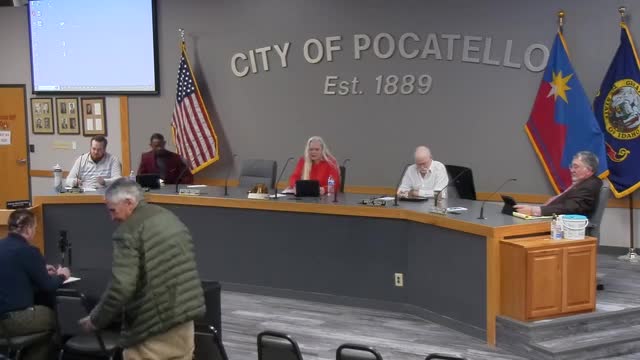
Summary
City planning staff asked the Pocatello City Council whether to proceed with a package of proposed updates to Title 17 zoning regulations that include a 25-year sliding grandfathering rule, restrictions on self-storage in commercial zones, conditional permitting and spacing for car washes, and reduced minimum lot sizes to allow higher housing density.
Jim Mangelsy, long-range planner for the City of Pocatello, and city planning staff briefed council members on proposed amendments to Pocatello City Code Title 17 and asked for direction on whether to proceed to ordinance drafting and public hearings.
"We are looking for your direction on whether we should proceed with these proposed amendments to title 17," Mangelsy said, introducing changes that range from administrative clarifications to use-table revisions and dimensional standards.
At the top of the list, staff proposed codifying a 25-year sliding grandfathering rule so that any structure 25 years or older (measured from the current date) would qualify as "grandfathered" if it does not meet current zoning standards. Mangelsy said the change would replace the longstanding, harder-to-administer 1981 cut-off and ease records review: "So anything 25 years or older, would then be considered grandfathered."
Planning staff also proposed amendments to the use table and development standards that would: make self-service (public) storage not permitted in Commercial General and Office Park zones (leaving only Light Industrial and Industrial zones as permitted locations); make car washes conditionally permitted in Commercial General (and not permitted in RCP) with development criteria and a proposed spacing requirement to limit clustering; reduce minimum lot sizes in several residential designations to allow greater density; and add flexibility to parking standards (including reduced parking in the original town site where off-street alternatives exist).
Brent McClain, planning director, explained the rationale for restricting some commercial uses. "We are occupying a major corridor of our commercial development with this industry," he said, pointing to a stretch of Yellowstone Highway that already contains several car washes and expressing concerns about commercial corridors being "swallowed up" by low-intensity uses. McClain said the conditional-use process and an applicant-provided market analysis would allow the city to decide whether a proposed car wash benefits a given commercial corridor.
Council members raised practical and legal questions. Council Member Waneta asked why self-service storage should be excluded from commercial zones; Mangelsy and McClain responded that storage uses often return less to local economic vibrancy than other commercial uses. Fire Chief Ryan O'Hearn said he had no immediate data showing increased fire risk at self-storage facilities but offered to research relevant code and hazards. City Attorney Jared Johnson told the council an outright numerical cap on a business type would be difficult to defend legally, but permitting standards and spacing requirements are within the city's zoning authority and could be justified with a governmental interest.
Council Member Nichols and others questioned singling out car washes for a market study when the city does not require market studies for many other business types; Johnson said he would review the proposal with planning staff before any ordinance was drafted. "I will discuss with planning," he said, "I need to look more into that...we'll spend some time discussing that before we present a final ordinance for your consideration."
On housing standards, planners proposed reducing minimum lot sizes in several zones and adopting downtown development standards that would allow residential uses outright if they meet specified urban design criteria (for example, three-story buildings with an urban form and internal rather than external access). The change would also create parking ratios tied to unit size (one parking stall for a studio/one-bedroom, 1.5 for a two-bedroom, two stalls for three-plus bedrooms) to encourage smaller-footprint infill housing.
Council President Lohrick and others signaled general support for moving the package forward but asked staff to work with legal on the market study requirement for car washes and to refine definitions and code language before a formal ordinance. "If the market study is approved by legal as being something that is permissible, I would like it to be included when the ordinance comes forward," one council speaker said.
Staff said they would proceed to draft ordinance language, perform legal review of the market-study condition, and return with a formal ordinance and public hearing schedule if the council desired to move forward.