
Pocatello council approves taxi license for Angelina Rodriguez after appeal
Get AI-powered insights, summaries, and transcripts
Subscribe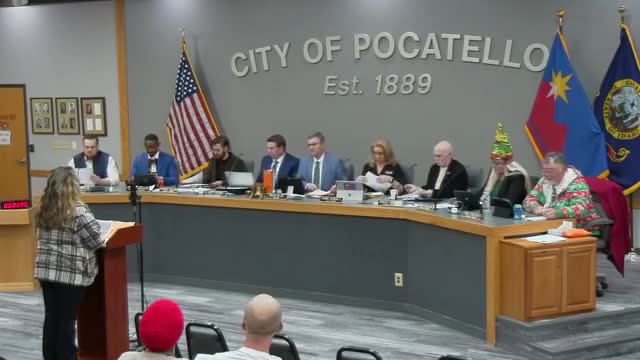
Summary
After hearing testimony about rehabilitation and reviewing a police licensing denial based on felony convictions, Pocatello City Council voted to grant Angelina Rodriguez a taxi license appeal and directed staff to finalize licensing steps.
The Pocatello City Council on Dec. 12 approved an appeal by Angelina Rodriguez to overturn a Pocatello Police Department denial of her taxicab license application.
Rodriguez, who spoke during agenda item 6, told the council she has been working on sobriety, attending counseling and reentry programming and completed recovery coach training. “I just wanna tell you about a few things that I’ve accomplished through my sobriety,” she said, presenting support letters and certificates to the council.
The appeal was necessary because the police licensing officer, Mallory Bascom, cited city code 5.56.050(E), which bars applicants with felony convictions. Bascom summarized Rodriguez’s record on the record, saying it included felony DUI convictions in 2010, 2016 and 2018 and a 2016 conviction for possession with intent to deliver. Bascom also told the council she had verified Rodriguez disclosed those convictions on her application and reported no new convictions since 2018.
Council members asked Rodriguez about relapse history, current parole status and treatment steps. Rodriguez said she last relapsed about eight months ago following the 2023 death of her mother, that she is enrolled in grief and trauma counseling and the GEO reentry program and that she expects to complete parole in June 2025.
Sylvia Buck, who identified herself as Rodriguez’s employer, told the council Rodriguez has worked for her as a housekeeper since 2021 and described her as “very reliable, very trustworthy.”
Council Member Joshua Mansfield moved to approve the appeal and grant the taxi license; Council Member Joshua Mangum seconded the motion. After roll call, the motion carried with Mansfield and Mangum voting yes, Council Member Cheatham voting no, Council Member Florrick voting yes, Council Member Nichols voting no and Council Member Paulson voting yes. The mayor instructed staff to work with Valerie to finalize licensing paperwork.
City code 5.56.050(E) provides the licensing standard cited by the police department; Bascom presented that code section as the basis for the original denial.
The council’s action overturns the licensing decision and directs staff to complete administrative steps for issuance; the applicant remains subject to the parole conditions and any ongoing requirements set by licensing staff.
Council members who voiced support cited addiction treatment, employment and recommendations from rehabilitation professionals as reasons for approval. “Addiction is a disease,” Mansfield said during debate, urging the council to consider employment as a path to reducing recidivism. Council members who voted no referenced the seriousness of the applicant’s criminal history.
Mayor Platt and licensing staff did not announce any additional conditions on the license at the meeting; staff indicated they would follow standard administrative procedures to issue the license.