Get Full Government Meeting Transcripts, Videos, & Alerts Forever!
Get email alerts on the Impact Fees topic
No spam. Unsubscribe anytime.
Ada County seeks Meridian—s cooperation on countywide impact fees for jail, EMS and coroner services
Summary
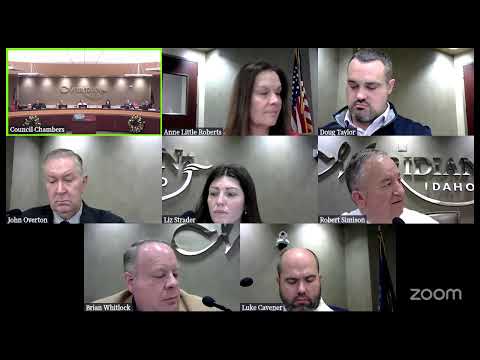
Ada County and the Ada County Emergency Medical Services District on Dec. 17, 2024 asked the Meridian City Council to consider participating in a countywide development impact-fee program to fund jail expansion, emergency medical services and coroner facilities.
Ada County and the Ada County Emergency Medical Services District asked the Meridian City Council on Dec. 17, 2024, to consider a cooperative, countywide development impact fee program to help pay for future jail, emergency medical services and coroner facilities.
City staff described the request as informational, not an action item. Kurt (city staff) told the council the county needs participating cities because Idaho courts limit county ordinances to unincorporated areas; to cover incorporated areas the county must secure each city—s cooperation through an intergovernmental agreement and adoption of the county—s capital improvement plans (CIPs). Colin McElhinney of Tischler Bise, the county—s consultant, described the methodology and preliminary fee calculations used in the countystudy.
Why it matters: the county is proposing fees that would be charged to new development to preserve current levels of service as the county grows. County staff and consultants said the approach mirrors incremental expansion methods used in local impact fee studies and would fund facilities countywide—but the proposal requires Meridian and other cities to adopt the county CIPs and pass city ordinances to collect the fees within city limits.
What county staff proposed: McElhinney summarized a 10-year capital plan and the incremental-expansion method the county used to set maximum supportable fees. Examples cited in the county presentation included per-unit figures under the study—s maximum supportable amounts: about $516 for jail costs per single-family home, roughly $117 per single-family home for EMS, and roughly $59 per single-family home for the coroner component. Combined, the countywide maximum per single-family home appeared in the presentation at about $750 for the three categories together if all cities participate. McElhinney said jurisdictions could adopt lower fees than the maximum the study supports.
Council concerns and legal questions: council members and city attorneys emphasized that the county lacks the statutory authority that Ada County Highway District has to pass and enforce countywide impact-fee ordinances in incorporated cities. City attorney Kurt identified two legal risks: (1) this is one of the first countywide programs of its kind in Idaho and it tests statutory limits; and (2) Idaho—s development impact fee statute lists categories and the coroner does not appear explicitly in the statutory examples of public safety facilities, creating some legal uncertainty about whether a coroner fee would withstand legal challenge. Kurt recommended contractual protections in any intergovernmental agreement, including indemnification clauses in which the county would defend the city against legal challenges.
City staff—s recommended next steps: Meridian staff proposed a cautious four-step approach in the council packet: (1) negotiate and sign an intergovernmental agreement that commits the city to consider (but not adopt) the county—s CIPs; (2) rely on the county—s development-impact-fee advisory committee for technical review; (3) hold the required public hearings on adoption of CIPs and incorporate adopted CIPs into the city comprehensive plan; and (4) pause until other cities move forward, then consider a city ordinance to collect fees on behalf of the county so Meridian is not the only jurisdiction collecting the county fees.
County stance and appetite for change: Ada County—s presentation team said the county commissioners have included the CIP-based, maximum supportable fees in planning documents and are ready to move forward but do not intend to charge impact fees in unincorporated areas until cities agree to participate—county staff repeatedly said they prefer a joint, —trust circle— approach where cities adopt CIPs together rather than one city moving first and creating an unlevel playing field for developers.
Remaining questions and council feedback: council members asked whether the county would consider decoupling categories (for example, collecting fees in unincorporated areas for facilities that are used only there). County staff said they had not fully considered decoupling but could. Several council members suggested the county pursue clarification or additional authority from the Idaho Legislature but others warned that legislative change is uncertain and could create additional legal exposure. The city attorney repeated that any intergovernmental agreement should include strong indemnification and limit the city—s obligations until other jurisdictions participate.
What—s next: the item was informational and the council did not take action. City staff asked for direction on whether to pursue the proposed four-step approach and to continue negotiations with the county; any formal city decisions (CIP adoption or an ordinance) would require separate public hearings and ordinance votes.
Sources: Meridian City Council work session, Dec. 17, 2024; presentation by Colin McElhinney, Tischler Bise; city staff memo and draft intergovernmental agreement (City of Meridian); comments by Kurt (city staff) and city attorney (Kurt).