
Planning Commission recommends engineering standards manual to council with curb exclusion and delayed road-width change
Get AI-powered insights, summaries, and transcripts
Subscribe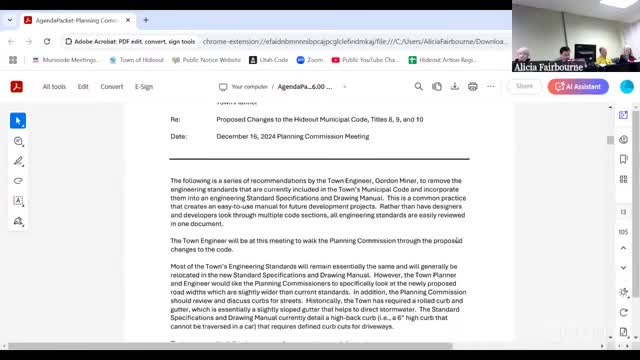
Summary
The Hideout Town Planning Commission on Dec. 16 voted to recommend that the Town Council adopt a codified engineering standards manual and an ordinance removing engineering standards from the town code, while excluding a proposed curb change and delaying the new road-width standard until June 1, 2025.
The Hideout Town Planning Commission on Dec. 16 voted to recommend that the Hideout Town Council adopt a codified engineering standards, specifications and drawing manual and approve an ordinance removing engineering standards from the town code, with two explicit exceptions: the commission declined to adopt the proposed change to a high-back curb and set a June 1, 2025 effective date for the revised street-width standard.
The recommendation matters because the manual consolidates technical engineering requirements now embedded in multiple sections of the town code into a single, codified-by-reference document intended to be easier for developers and engineers to use and for staff to apply in plan review.
Commissioners and staff spent the bulk of the meeting discussing two principal engineering changes in the draft manual: a modest increase to local street traversable pavement to accommodate parking on both sides while meeting fire department clearance requirements, and a proposed switch from the current mountable rolled curb to a non-mountable 6-inch high-back (urban) curb. Gordon (staff member/engineer) told the commission that the proposed traversable pavement width was driven by the fire code requirement for emergency vehicle access, saying, "the width of the proposed local street is based on the fire code" and later, "parking... is causes problems, quite a bit in in Hideout." He described the recommended typical local-access cross section as 30 feet of asphalt plus curb/pan yielding approximately 33 feet of traversable pavement compared with the town's existing typical 29 feet.
Several commissioners raised enforcement and design concerns. Commissioner Tony (Planning Commissioner) questioned whether widening streets would simply accommodate illegal winter parking rather than reduce it, and argued enforcement of the existing parking rules would obviate the need to widen streets. Lisonbee (Planning Commissioner) and other members expressed concern about speed: "there's no doubt the narrower the street... the wider the street, the faster people go," one commissioner observed, noting a trade-off between emergency access and traffic calming. Commissioners also questioned how the change might affect developments that have advanced concept plans, including whether plan sets would need revisions.
Staff said projects with vested approvals or filed preliminary applications before the changes were presented would remain subject to the older standards. Gordon clarified the manual would be "code by reference," telling the commission, "this will still be code. It's just code by reference." Commissioners asked that the commission's recommendation identify exceptions and an implementation timeline to avoid unfairly penalizing developers who have been working on concept plans.
After discussion, Commissioner Holly moved to forward a positive recommendation with two amendments: (1) do not adopt the proposed high‑back curb change, and (2) make the revised local street width standard effective June 1, 2025. The motion passed by a 4–1 vote (Joel: yes; Rachel: yes; Glynis: yes; Donna: yes; Tony: no). The commission then separately voted to forward a positive recommendation to adopt an ordinance removing the engineering standards from the town code; that motion passed unanimously.
No members of the public spoke during the public-comment period on this item.
Next steps: The commission will forward its recommendation, with the specified exceptions and effective date, to the Hideout Town Council for their consideration. Staff said the manual is intended to be a clear checklist that engineering and subdivision submissions must satisfy during review; Gordon indicated plan sets that are noncompliant would return to applicants for revision before being forwarded for commission action.
Ending note: At the end of the meeting staff signaled that an update to the town's general plan will be brought to the commission at the next meeting for review and input; staff noted the current general plan dates to 2019 and recommended commissioners review it on the town website before the next session.