Get Full Government Meeting Transcripts, Videos, & Alerts Forever!
Get email alerts on the Subdivision Ordinance topic
No spam. Unsubscribe anytime.
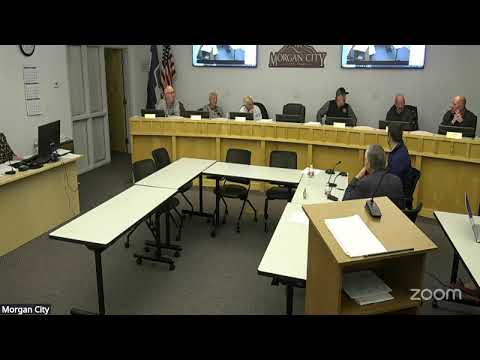
Morgan City adopts updated subdivision ordinance shifting approvals to planning commission and staff
Summary
The Morgan City Council adopted Ordinance 2414 on Jan. 28, revising subdivision regulations to give the Planning Commission authority for preliminary plats and an administrative land use authority (city staff and designated professionals) responsibility for final-plat approvals, while simplifying bonding and guarantee procedures.
Morgan City Council on Jan. 28 unanimously adopted Ordinance 2414, a comprehensive revision of the city’s subdivision regulations that reassigns certain plat approvals and simplifies bonding and improvement-guarantee procedures.
The ordinance implements changes required by state law and local streamlining measures, most notably: preliminary‑plat approval will be performed by the Planning Commission; final plats for most projects will be approved by an administrative land use authority (described in the ordinance as “individuals designated by the city,” typically planning, engineering and legal professionals, and supported by public works and utilities); and administrative procedures and definitions were consolidated into the zoning and land‑use code.
Planner Jake Young walked the council through the main changes and Gary Crane, the city attorney, explained how the bonding and “methods in lieu of actual improvements” sections were simplified. Under the revised approach the city accepts two primary forms of improvement assurance (escrow deposit or cash bond) and removed a duplicative provision that had allowed depositing a cashier’s check with the city. The ordinance also reflects the state-mandated 12‑month warranty period for completed improvements (the statutory period for an improvement guarantee), with the city engineer retaining authority to approve extensions in limited circumstances.
Council and staff discussed several operational details during the meeting: when bonds or escrow are required, who estimates the cost (the city engineer), how partial releases and final (conditional) acceptance are handled, and how the city will treat trust deeds, letters of credit, and surety bonds (those methods were removed or discouraged in favor of cash or escrow because of collection and liquidity concerns). The adopted language shifts several release and final-acceptance authorizations from the city council to the administrative land use authority or city staff because the engineer and inspectors perform the field verification over the improvement period.
The ordinance also preserves a cost‑sharing/payback mechanism to allow oversizing of infrastructure paid for by a developer when larger capacity benefits future development, but clarifies that “proportionate share” calculations will exclude the minimum utilities required to serve the subdivider’s own lots (the ordinance seeks to avoid charging subsequent developers for minimum infrastructure the initial developer was required to install).
Council member Dave Alexander moved to adopt Ordinance 24‑14 with the changes discussed during the meeting; Jeffrey Richards seconded. The council approved the ordinance by roll call vote: Jeffrey Richards, Hugh Fordell, Eric Turner, Dave Alexander and Tony London voted aye.
Why it matters: the ordinance updates local subdivision procedures to conform with state law, reduces ambiguity in how improvements are guaranteed, and delegates routine final-plat approvals to staff to speed approvals while keeping planning commission review for preliminary plats.
What’s next: staff will publish a clean copy of the ordinance incorporating tonight’s edits, update the standard improvement‑assurance agreement form, and apply the new process to pending and future subdivision applications.