
Planning commission reviews ordinance change to raise short-term rental fines; forwards numeric tweak to council
Get AI-powered insights, summaries, and transcripts
Subscribe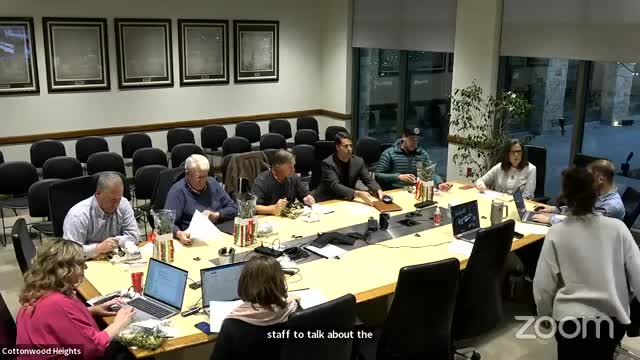
Summary
Staff proposed a zoning text amendment to raise daily penalties for short-term rental ordinance violations to $650, $800 and $1,000 for the first, second and third violations respectively. Commissioners discussed enforcement limits, evidence requirements and outreach; the commission will forward a recommendation to city council.
At a Dec. 4, 2024 work meeting, staff presented a zoning text amendment that would increase financial penalties for repeated short-term rental ordinance violations and asked the Planning Commission to forward a recommendation to the City Council.
The proposed amendment, prepared by the city attorney and reviewed by the police department, would set the first violation at $650, the second at $800 and a third (and subsequent) violation at $1,000 per day, with each day of continued operation after notice treated as a new penalty. Scott, a planning staff member, said, “By ordinance, each day, unit operates in violation constitutes a new penalty.”
The proposal is limited to enforcement adjustments and does not change where short-term rentals are allowed or other policy provisions. Scott told commissioners the change was intended as “a tool that was requested from the police department code enforcement side of things” to provide a stronger penalty for owners who continue to operate after being notified.
Commissioners and staff discussed enforcement mechanics and limits. Scott cautioned that fines are not automatically applied and that evidence collection and prosecution through the justice court are prerequisites: “It has to be evidence is collected. It's presented, through a prosecutor to a judge.” He also said the city contracts with Holiday Justice Court for enforcement hearings and that judges typically do not assess the maximum statutory fines, often opting for cease-and-desist orders or reduced amounts.
Speakers raised concerns about unintended consequences for owners who are unaware of the ordinance. Commissioners noted that many violations are resolved informally when code enforcement notifies owners and listings are removed, while repeat offenders are the target of the higher penalties. Commissioners recommended stronger public outreach and clearer guidance for prospective hosts; staff said Planner Maverick is developing a short-term rental web page and that an infographic and social-media outreach could be used to emphasize rules and steps to comply.
Staff acknowledged enforcement challenges, including the need for observable, documentable evidence beyond website listings. Scott said the amendment does not change evidence collection procedures; it would only raise the maximum penalty amounts available to a prosecutor and judge if a case proceeds.
The Planning Commission did not adopt an ordinance at the meeting. Commissioners were asked to review the numeric change and forward a recommendation; the amendment will next appear on the City Council agenda for a formal vote.
The commission also discussed broader policy work planned separately — including public open houses, focus groups, and comparative research with other municipalities — and emphasized that the numeric change was a near-term enforcement measure rather than the final policy on short-term rentals.