Get Full Government Meeting Transcripts, Videos, & Alerts Forever!
Get email alerts on the Land Use Zoning topic
No spam. Unsubscribe anytime.
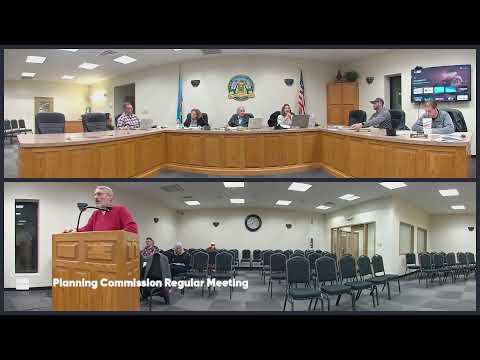
Commission backs rezoning and future land-use amendment to permit accessory building placement at 1951 NW Eighth St.
Summary
The commission recommended rezoning a 15-acre parcel and amending the 2020 future land-use map after an applicant could not place an accessory building without violating the E-1 district regulations.
The New Castle Planning and Zoning Commission on Jan. 27 recommended approval of a rezoning and a corresponding amendment to the future land-use map so an applicant can place an accessory building where site topography prevents compliance with E-1 suburban estate residential rules.
Senior planner Kevin Hagbert told commissioners the application (R2025-001) concerns a roughly 15-acre tract north of Eighth Street. "R2025-001 is a rezoning of a 15 acre tract on North Of Eighth Street from E-1 suburban estate residential to a general agricultural," Hagbert said. He explained that a proposed accessory building location would have been in front of the main dwelling under the existing E-1 rules, which the district does not permit.
Hagbert said the applicant first sought a building permit for a single-family structure and later for an accessory building; topography left no compliant placement for the accessory structure. "The board of adjustment isn't an entirely appropriate mechanism to be used for this, and then looking at rezoning to a general agricultural that does have the provision that accessory structures can be in front of the main dwelling unit," Hagbert said. To align zoning with the desired accessory-building placement, staff recommended rezoning the parcel and amending the future land-use map from suburban estate residential to state residential, which accommodates general agricultural zoning.
Commissioners discussed the potential precedent for other owners along Northwest Eighth Street, which Hagbert noted contains lots generally larger than five acres; he said other property owners could consider similar requests in the future. The commission moved to recommend approval of both the rezoning and the future land-use amendment; the motion passed unanimously.
The staff report and Hagbert's presentation indicate the change is intended to allow a specific accessory structure placement consistent with site conditions and to align the future land-use designation with the zoning requested. The commissioners recorded no public opposition during the hearing.
The commission forwarded its recommendation to the city council for final action, and staff will update applicable permit and land-use records if the council approves the amendment.