
Indian Trail board holds training on quasi‑judicial variances; chair, vice chair confirmed
Get AI-powered insights, summaries, and transcripts
Subscribe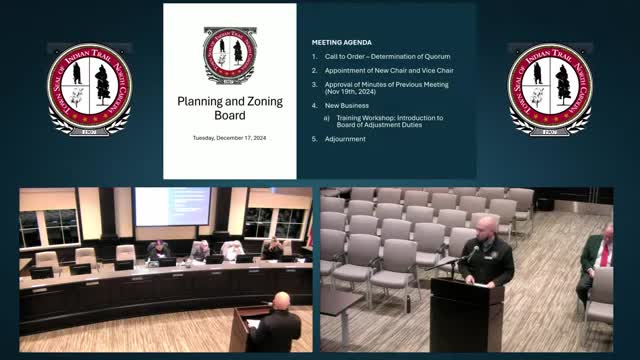
Summary
The newly combined Planning and Zoning Board received a training on quasi‑judicial procedures and variance standards, including evidentiary rules, recusal and voting thresholds. The board also appointed Cynthia Wiley as chair and Meg Fielding as vice chair and approved prior minutes.
Cynthia Wiley, chair of the Planning and Zoning Board in Indian Trail, opened the Jan. 8 training meeting and was reappointed chair by the board; members also confirmed Meg Fielding as vice chair and approved the Nov. 19, 2024 minutes.
The main portion of the meeting consisted of a staff‑led training on quasi‑judicial hearings and the five legal standards for granting variances, delivered by planning staff (Brandy). The session covered who may participate in a quasi‑judicial hearing, what constitutes admissible evidence, how to handle ex parte communications, recusal procedures, and the heightened voting threshold for approving variances.
The training emphasized that quasi‑judicial hearings are evidence‑based proceedings that operate much like a court: testimony is sworn, the board must base decisions on competent evidence rather than public opinion, and the burden of proof lies with the applicant. As Brandy, a town planning staff member, put it: "A quasi judicial hearing is like a court like procedure where a formal judgment is rendered over the application of the law." She told board members that only parties with legal standing and qualified witnesses should participate in the evidentiary record and that the chair should remind the room that decisions must be grounded in facts.
Brandy walked members through the typical hearing phases — opening/setup, evidentiary hearing (staff, applicant, parties and witnesses), deliberation and written decision — and pointed them to the training packet for chapter and page references. The packet and presentation break the variance standards into two principles: (1) unnecessary hardship that arises from conditions unique to the property (not from owner circumstance or self‑created conditions), and (2) consistency with the spirit, purpose and intent of the zoning regulations so that public safety and substantial justice are secured.
The training also covered procedural safeguards. Board members were instructed to disclose site visits or other ex parte contacts at the start of each case and to recuse themselves where a conflict exists. Brandy noted that testimony can be "moved to strike" if a party with standing demonstrates it is inadmissible. Board members were urged to frame deliberations around applicable facts and standards rather than personal preferences; Brandy advised against phrasing determinations in terms such as "I think" or "I feel."
Members were reminded that approving a variance requires a supermajority: four‑fifths of the sitting board (for example, five affirmative votes on a six‑member board). A denial of a variance requires only a simple majority. The requirement for written findings was stressed: the board's decision must list contested facts, indicate which standards were met or not met, and explain how conflicting evidence was resolved.
To illustrate the procedures, staff ran a short mock hearing for a hypothetical "Jackson's Pool" variance. The mock included a disclosed family relationship and a formal recusal (accepted by the board), an objection from an applicant in the simulation and a majority vote resolving a participation objection, a deliberation demonstrating how members should state standards‑based reasoning, and two final motions: one to adopt findings of fact and one to approve the variance. During the mock exercise the board voted, by show of hands, to adopt findings of fact (5–0) and to approve the variance (5–0); trainers repeatedly noted the exercise was a simulation and not an actual development application.
Votes at a glance - Appointment of chair: Motion to appoint Cynthia Wiley as chair (moved by a board member, seconded); motion passed (recorded aye votes present; other individual vote details not specified in the record). Note: Cynthia Wiley had stated she would be "delighted to continue on as Chair." - Appointment of vice chair: Motion to appoint Meg Fielding as vice chair (nominated by Cynthia Wiley), seconded and approved unanimously as recorded in the meeting. - Approval of minutes: Motion to approve the Nov. 19, 2024 minutes as submitted; motion seconded and approved (ayes recorded; the record states the motion passed).
The training materials and slide references given in the session (chapters and pages in the board packet) were distributed to members after the meeting. Staff said they would also provide the PowerPoint slides and recommended members view a previous Board of Adjustment meeting available on YouTube (Oct. 15, 2024) to see a full hearing in practice.
The meeting closed after a brief question‑and‑answer period in which staff reiterated that planning staff would flag weak variance requests before they are scheduled, and that the board can request legal counsel if a case appears likely to lead to litigation. The session concluded with thanks to the members and their families and adjournment.