Get Full Government Meeting Transcripts, Videos, & Alerts Forever!
Get email alerts on the Franchise Fee topic
No spam. Unsubscribe anytime.
Johnston City Council adopts revenue purpose statements and advances 5% electric, gas franchise ordinances
Summary
The council adopted revenue purpose statements and approved first readings of ordinances to raise electric and gas franchise fees from 1% to 5% to help fund a 5‑year staffing plan, with an emphasis on public safety positions.
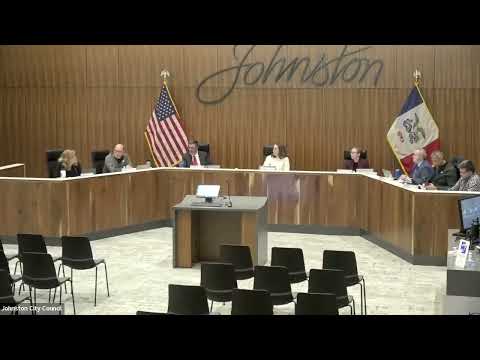
The Johnston City Council on the evening of its meeting adopted revenue purpose statements and gave first consideration to ordinances to raise electric and gas franchise fees from 1% to 5%, moves staff said are intended to fund a five‑year staffing plan focused on public safety.
City staff told the council the current 1% franchise fee generates about $295,243 annually and that a 5% fee would generate roughly $1,476,215 annually. Mike, a city staff member who presented the proposal, said the increase would help pay for new positions in police and fire departments and support administrative functions that serve those departments.
The revenue purpose statements for the franchise fees were approved by resolution (No. 25‑26 for electric; No. 25‑27 for gas), and the council approved first consideration of ordinance No. 1129 (electric) and ordinance No. 1130 (gas).
Why it matters: City staff framed the franchise fee as an alternative revenue source to property tax increases, and said the fee spreads costs to utility customers and to nontaxable entities that receive city services. The city’s staffing plan includes 16.5 public safety positions over five years—6.5 in the police department and 10 in the fire department—and staff said recent workload increases in both departments are driving the request.
City staff provided several data points in support. Mike said police documented activities rose about 27% from 2019 through 2024, with an all‑time high of 34,915 documented activities in 2024. He said fire call volume increased roughly 49.8% over five years, with 4,426 calls in 2024.
The staffing and revenue plan discussed by staff would phase implementation: a 5% franchise fee in 2026; a flat property‑tax levy in fiscal 2026; and then an annual property‑tax increase of 10 cents per $1,000 of assessed value in 2027–2030 (totaling 40 cents) to fund the full staffing plan.
Council members asked for additional context on which land and entities are nontaxable. Mike referenced the city’s Thrive 2040 plan: roughly 44% of the city’s land area is nontaxable when parks, Camp Dodge, Saylorville Lake, rights of way and other public or semi‑public uses are included. A council member noted that some major nonprofit employers that were added after the Thrive 2040 data (for example, LifeServe) could increase the share of nontaxable acreage.
No members of the public addressed the council during the franchise‑fee public hearings.
Council action and procedure: The council adopted the revenue purpose statement and approved first consideration of the electric ordinance (No. 1129) and the gas ordinance (No. 1130). The staff presentation and council discussion took place during the public‑hearing period for each franchise ordinance; the council then voted on the resolutions and on first reading for both ordinances.
What the money would buy: Staff said the franchise revenue is intended primarily to support added public‑safety staffing in the five‑year plan but also to support administrative and quality‑of‑life functions across departments. Mike described the purpose as maintaining service levels as the community grows at an estimated 2–3% annually.
Next steps: Under the city’s process, first reading of the ordinances advances the measures; additional council consideration and public notice are required before final adoption. Staff and council also noted the franchise approach was chosen in part to reduce reliance on property taxes and to collect revenue from utilities that serve many nontaxable properties.
Resolution and ordinance identifiers: Resolution No. 25‑26 (electric revenue purpose statement); Ordinance No. 1129 (electric franchise ordinance, first consideration); Resolution No. 25‑27 (gas revenue purpose statement); Ordinance No. 1130 (gas franchise ordinance, first consideration).
Ending: Council members said they will continue budget discussions in future meetings as the city refines how the additional revenue would be allocated across departments and the timing of personnel hires.