Get email alerts on the Program Administration topic
No spam. Unsubscribe anytime.
Commission hears Howard and Montgomery County experiences, approves edited summary guide and FAQs
Summary
Representatives from Howard and Montgomery counties described their early experiences with public election funds; Baltimore County commissioners approved technical edits to the local Summary Guide and FAQs and discussed outreach strategies and reporting timelines.
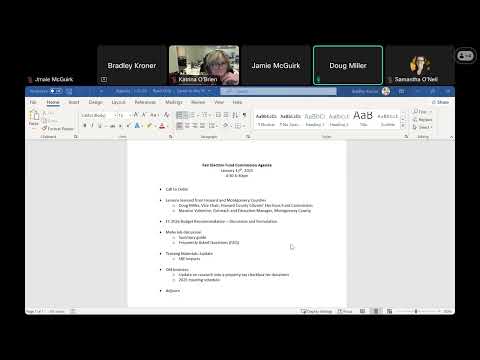
Baltimore County's Fair Election Planning Commission heard practitioners from Howard County and Montgomery County on Jan. 13 before approving technical edits to its Summary Guide and frequently asked questions (FAQs) for the public election fund.
Doug Miller, vice chair of the Howard County Citizens Election Fund Commission, described Howard County's start-up experience, noting that the program required a charter amendment and that his commission encountered operational "growing pains" during its first active election cycle. He said the Howard County fund applied to county executive and council races, that participation in the first funded election was not a majority of candidates, and that the commission had to amend county rules to address timing issues that had disadvantaged an incumbent running unopposed in a primary. Miller emphasized the staff time required to prepare clear FAQs and summary materials for candidates.
John Valentine, public election fund liaison for Montgomery County, described the outreach and service model Montgomery used after the county created a liaison position. Valentine said his office created a website with a contact form and a speaker-request form, produced fact sheets and PowerPoint presentations, and developed a receipt-review process to help candidates format reimbursement requests correctly. He told the commission Montgomery had 30 candidates seek public funding in one cycle, 20 of whom were certified; of those certified, eight won their primary contests and eight won in the general election. Valentine said Montgomery's Office of Legislative Oversight produced a report (posted Oct. 2024) that includes recommendations, and he said Montgomery's advisory committee had recently been dissolved under a new amendment.
After the presentations commission staff described two technical changes to the Summary Guide the commission was asked to approve: first, a clarification of the permissible sources of funding for the Fair Election Fund, including a sentence explaining that voluntary public contributions may be accepted; second, expanded detail in the reporting schedule that explains optional filing windows during the calendar year before an election and lists the additional Tuesdays during the election year when committees may submit supplemental reports to request public funds. Staff noted that, under current law and practice, the county cannot issue public funding checks earlier than June of the election year.
Commissioners voted unanimously to approve the revised Summary Guide and the FAQs submitted with the meeting materials. They asked staff to post the updated documents to the county website, to create candidate welcome packets for the county board of elections office, and to coordinate with the State Board of Elections on training materials once the statewide filing software is updated. Commissioners also discussed and declined a proposal to solicit voluntary contributions via the county property tax billing process, with staff reporting that the administrative cost and low expected reach made the approach impractical.
Commissioners were advised to review the FAQ document before the February meeting, when they will have another opportunity to suggest edits. Staff said they will continue outreach to central party committees and community organizations and will circulate updated materials and a public information plan ahead of the 2026 filing season.
AI generated
The text on this page is AI generated. Summaries, highlights, analysis, and video transcripts are all produced from the original source material.
AI can make mistakes, so if you spot one, and we will fix it for everyone.
Note: the source content is unaltered by us. Any content source we link to, be it a video, an audio recording, or a document, is presented exactly as its publisher released it. That publisher is usually a government body, sometimes an individual official or another organisation.