Get Full Government Meeting Transcripts, Videos, & Alerts Forever!
Get email alerts on the Public Comment And Decorum topic
No spam. Unsubscribe anytime.
Glendale council reviews formal rules for public comment, decorum and meeting cameras
Summary
City staff presented options to standardize public comment times, decorum enforcement, council debate limits, meeting cutoff time and camera angles after several recent disruptions; councilmembers asked for refinements and staff follow‑up.
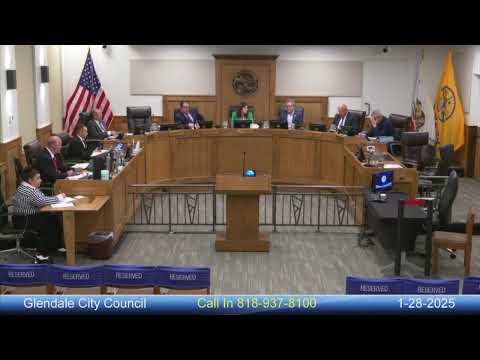
City Attorney staff presented a formal review of Glendale’s rules for public comment, meeting decorum and council deliberations during the Jan. 28 Glendale City Council meeting, urging clearer written procedures while recognizing the Brown Act’s free‑speech and limited‑forum constraints. The presentation surveyed other jurisdictions’ public‑comment systems and offered options on speaker time limits, combining comment periods, handling disruptive behavior and whether cameras should show wide views of the audience.
The staff report summarized what other cities do and emphasized that the Brown Act allows cities to adopt viewpoint‑neutral, reasonable rules for meetings. “The Brown Act requires that the public have the opportunity to speak on agenda items before, during the discussion and also speak on matters that are within the subject‑matter jurisdiction of the council,” City Attorney Mike Garcia said during the presentation. Garcia reviewed case law and recommended codifying procedures for warnings and removals when conduct is disruptive, while preserving ordinary protections for offensive but protected speech.
Councilmembers debated several specific options. On public comment format, council members split over whether to combine agenda and non‑agenda comments in a single early period or keep separate periods and allow speakers who come early to speak on agenda items. Several councilmembers supported creating a consolidated early public‑comment period (chairable community/announcement block) limited to 30 minutes, with 3‑minute speaker maximums and the presiding officer (mayor) retaining discretion to shorten time when many speakers are present. Members also asked staff to preserve the city code’s five‑minute “oral communications” provision unless the council amends the municipal code.
On decorum and removal, Garcia recommended requiring at least one explicit warning before removing disruptive individuals (except where immediate force or threat of force is present) and recommended written rules on signs, ceding of time and addressing the dais rather than the room. Councilmembers asked staff to clarify procedures for points of order and appeals of chair rulings; the city attorney advised that points of order remain available under the rules and that a council decision to overturn a chair’s ruling requires a majority vote.
Camera angles and audience visibility drew sustained discussion. Some councilmembers argued that showing speakers’ faces increases transparency for remote viewers; others said showing wide shots of the audience has led to viral clips and made some speakers targets of public ridicule. Multiple councilmembers favored a compromise (split or dual display) and asked staff to propose a specification that would limit wide audience shots during quasi‑judicial hearings while preserving broader views for oral communications or community announcements.
Council members also discussed the idea of a meeting cutoff time (staff noted other cities use an 11 p.m. benchmark). Several members said a formal cutoff that requires consultation with the city manager before proceeding past the hour would help protect public participation and staff workload; staff agreed to draft language modeled on neighboring cities’ practices. On council deliberation, options included a first round for every member, with subsequent rounds limited and the mayor speaking last; some members asked only for procedural reminders rather than hard time caps.
The council did not adopt new rules at the Jan. 28 meeting. Councilmembers directed staff and the city attorney to return with a resolution and draft code amendments that would: (a) formalize warning/ removal procedures for disruptive conduct consistent with case law and the Brown Act; (b) present options for early consolidated public comment (30 minutes) with 3‑minute default time and mayoral discretion; (c) propose a meeting cutoff procedure (example: 11 p.m., with council majority able to extend); and (d) propose camera‑angle guidelines, including a default for showing speaker faces with limited audience wide‑angle for certain meeting segments. Staff said it would circulate proposed language and sample rules from peer cities for council review.
Councilmembers asked staff to make the draft easy for the public to follow and to consult with the city clerk and the city’s broadcast/IT staff on implementable camera settings. The city attorney reiterated that any adopted rules must be viewpoint neutral and reasonable for a limited public forum.
Ending: Staff will return with a proposed resolution and draft municipal‑code amendments for council consideration; no formal rule change was enacted at the Jan. 28 meeting.