Get Full Government Meeting Transcripts, Videos, & Alerts Forever!
Get email alerts on the Parks And Recreation topic
No spam. Unsubscribe anytime.
Coconino advisory group reviews parks, open-space and trails chapter; debate focuses on wording, mapping and OHV impacts
Summary
Coconino County’s comprehensive-plan advisory group reviewed the draft Parks, Open Space, Trails and Recreation chapter in a hybrid meeting, pressing staff for clearer maps and glossary entries, debating whether to keep the word “mitigate” in climate language, and raising enforcement and funding concerns about off‑highway vehicle impacts on trails and natural areas.
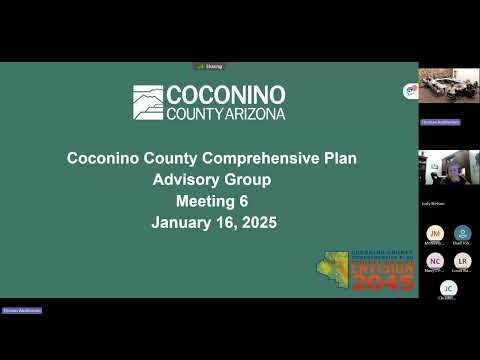
Coconino County’s comprehensive-plan advisory group reviewed the draft Parks, Open Space, Trails and Recreation chapter during a hybrid advisory meeting, with Parks and Recreation staff and wildlife planners answering questions and advisory members proposing wording changes, map corrections and policy additions.
The draft chapter was presented by county Parks and Recreation staff, who described county-managed parks, natural areas and the trails the department maintains. Cynthia Newman, Parks and Recreation director, introduced the county parks material and staff: “I’m Cynthia Newman, and I’m the Parks and Recreation director.” Jessica Simmons, wildlife planner, added her role: “I’m Jessica Simmons. I’m the wildlife planner for the county. I work with Melissa, and, incidentally, I also work for Parks and Rec.” Liz, Parks Recreation staff, answered trail and recreation questions: “This is Liz from Parks Recreation. I can speak to a little bit of that.”
Advisory members requested specific edits and clarifications. Several members asked for wording changes to the chapter’s climate language: advisory member Jim Parks proposed removing the word “mitigate” and inserting “weather patterns” in the phrase that currently reads “mitigate and adapt to climate change.” After discussion, some members and staff supported keeping “mitigate” to preserve an active responsibility in the language; advisory member Thad said, “I tend to like mitigate in the sentence also because it it reminds us that as we make decisions and do things that we want to take into account the impact.” The group agreed to retain mitigate while changing the phrase to reference “changing weather patterns.”
Members also asked for a clearer reference to lake-level impacts. Jim Parks asked that the line mentioning “decreasing water levels in Lake Powell” be clarified to read “decreasing lake water levels, including Lake Powell,” noting there are many lakes in the county.
On parks facilities, advisory members proposed adding activities to the county list of equestrian facilities and related events. A member asked that the chapter’s sentence listing equestrian arenas be expanded to include “rodeo, horse racing” in addition to arenas and stables.
The group asked staff to define or add a glossary entry for the term “hardscape parks” (used to mean developed parks with courts, playgrounds, paved paths and parking). Staff confirmed the glossary will be provided and that the chapter’s blue links will point to more detailed documents, including the county Parks and Recreation master plan.
Trails: scope, mapping and permits
Advisory members pressed for clarity about trails the county manages versus trails on other jurisdictions. Staff said the county does not have a comprehensive countywide trails map that isolates only county-managed trails and recommended clarifying the text to state that the county provides recreational multiuse, non-motorized trails within county parks and natural areas rather than implying county management of trails across all jurisdictions. As staff put it, “We, we do not have a comprehensive trails map that shows just the trails that our department manages because on a county level, those would be very small. But we can certainly state which trails they are, and the trails are in the county managed parks and natural areas.”
The chapter highlights larger regional routes such as the Arizona Trail; advisory members noted the map needs labeling fixes and a clearer legend. Several speakers also raised the Great Western Trail, saying parts of that trail cross private lands and multiple jurisdictions and that motorized route proposals have drawn opposition from agencies and stakeholders.
Off-highway vehicle (OHV) impacts and enforcement
Advisory members and staff discussed recreation-related resource impacts, especially from OHVs and razors. Speakers described past education and infrastructure efforts (including temporary dumpster placement) that were not widely used, and said enforcement is limited by the county’s jurisdiction and sheriff resources. Liz from Parks and Recreation described prior coordinated outreach and trash-management efforts and noted mixed results. An advisory member said a bill addressing OHV impacts — described in the meeting as titled “All 4 Vehicles” and scheduled for introduction the following week — could change state-level approaches to OHV damage and enforcement.
Multiple speakers stressed that OHV impacts are handled across jurisdictions and that Arizona Game and Fish, the U.S. Forest Service and private landowners all play roles in managing recreational use.
Tribal access and Indigenous names
Advisory members asked for clearer policy language on tribal coordination for cultural and ceremonial sites and suggested adding a policy encouraging use of Indigenous place names on signage, interpretation and when naming new county facilities — while noting sensitive sites should remain protected from public disclosure.
Permits, special events and funding
Staff clarified that the county issues trail permits for organized events (for example, races) but does not issue individual-use permits for casual visitors; advisory members suggested considering priority or reservation options for local users if demand grows. Several speakers also raised the question of who pays for trail maintenance, enforcement and infrastructure; staff and members agreed funding is a recurring challenge and noted many responsibilities fall to county parks budgets, partner agencies and private landowners.
What happens next
Staff said the chapter will be revised to incorporate the suggested wording changes, glossary definitions, and map corrections, and will be circulated again to the advisory group. The advisory group signaled general support for retaining “mitigate” in the climate language while adjusting the phrasing to acknowledge changing weather patterns; they asked staff to clarify the scope of county-managed trails, add the glossary entry for “hardscape parks,” and to follow up on mapping updates and tribal coordination language.
Ending
Advisory members and county staff closed the parks discussion and moved on to the Land Use, Growth and Development chapter. Staff noted they will link the chapter to the Parks and Recreation master plan and to area plans (for example, Domino/Timberline/Fernwood area plans) where more detailed trail or land-use maps exist.