Get Full Government Meeting Transcripts, Videos, & Alerts Forever!
Get email alerts on the Municipal Budgeting topic
No spam. Unsubscribe anytime.
Charlottesville staff outline tighter FY26 budget, warn of federal funding uncertainty
Summary
City staff presented FY26 revenue projections showing smaller gains than recent years, described major expenditure drivers including collective bargaining costs and capital commitments, and set a timeline for a March public hearing on tax rates.
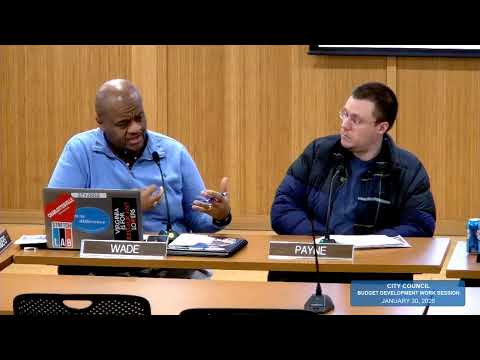
Charlottesville city staff told the City Council at a Jan. 30 budget work session that projected FY26 revenue gains are smaller than recent years and that several large cost items are already built into the proposed spending plan.
The update, delivered by Mr. Sanders and Miss Hamill during the council's budget work session, projected new general‑fund revenues for FY26 of just over $10 million, while noting that $3.4 million of increases tied to real‑estate and personal‑property taxes would be allocated to the Charlottesville City Schools under the city's 40% formula. Sanders said the remaining roughly $7 million would be available to the city for FY26 budget planning.
Why it matters: After several years of unusually strong revenues, staff said the city is returning to more modest growth. Councilors were warned that lower sales, meals and lodging tax receipts and uncertainty about federal funding streams could reduce the city's flexibility and increase the need to prioritize ongoing obligations.
City staff presented the revenue and policy context first. Hamill said the revenue team is still finalizing some numbers and that January reassessment figures already factored into the proposed FY26 totals. She cautioned several projections are “still under review.” The presentation flagged sliding payroll, lodging and sales tax receipts compared with earlier budgets and noted two unusually large building permits made FY25 an outlier on permit revenue.
Key budget drivers and assumptions discussed included the city's financial policies and specific cost items: the fund balance policy target of 17% (14% unallocated fund balance plus a 3% downturn reserve); a debt‑service policy that the city will not exceed 10% of the general fund (9% target); and an annual transfer equivalent to 1 percentage point of the meals tax to the debt service fund. Staff said utility funds (water, wastewater, gas and stormwater) and other non‑general funds must maintain positive working capital.
Sanders and Hamill listed several specific expenditure items already integrated into FY26 planning: the first year of the Teamsters contract with an estimated FY26 impact of $1.9 million; the second year cost of police, fire and transit contracts at about $2.6 million; a school request of $4.9 million (of which $3.4 million is covered by the 40% formula and Sanders said he was willing to program an additional $1.5 million); a $1 million annual share for jail renovations; a $1.3 million annual cash transfer tied to Carlton Mobile Home Park debt service; and roughly $1.5 million of additional debt service tied to recent bond decisions. Staff said new construction contributes minimally to next year’s real‑estate tax growth (about 0.4 percentage points on reassessment), and that much of the projected increase reflects reassessment assumptions that are partly uncertain for calendar year 2026.
Councilors pressed staff for clarity on assumptions, and staff identified the near‑term calendar for decisionmaking: the city manager plans to finalize a balanced manager's proposed budget by Feb. 14; the proposed budget will be delivered to council in early March; the council's first public hearing on tax rates is scheduled for March 17; and final adoption is targeted for April 14. Hamill reminded council that under a recent change to state requirements the city need only advertise tax‑rate public hearings seven days before the hearing.
Staff also flagged transportation and transit as the largest remaining unresolved area. Sanders said transitioning the transit fleet will increase vehicle costs and require additional bus drivers and mechanics; staff noted the system has not yet returned to pre‑pandemic driver staffing and that the transit director may request new drivers in future budgets. Staff said federal funding changes (e.g., Inflation Reduction Act or other federal grants) present a material risk: the city team is monitoring potential federal program reductions and is being conservative about one‑time spending to preserve flexibility.
Council direction and next steps: Sanders said he intends to present a budget that assumes no tax increase but warned that remaining uncertainties may require either expenditure reductions or new revenue before final adoption. He also said he had programmed the school request into the FY26 plan and had committed to an additional $1.5 million above the 40% formula at this stage; he noted that if the school's number changes, staffing or other expenditures would have to be adjusted.
The council left an open February 18 work‑session time slot for additional discussion if needed. Staff said some revenue items (business license renewals, building permits) will firm up in March and that the revenue team will continue monthly updates.