Get Full Government Meeting Transcripts, Videos, & Alerts Forever!
Get email alerts on the Affordable Housing topic
No spam. Unsubscribe anytime.
Kingdom CDC proposes 16-home affordable/workforce subdivision; commissioners ask for written scenarios before committing $1 million
Summary
Kingdom Community Development outlined a 16-unit single-family home project for Bladen County and requested a $1 million county contribution. Commissioners questioned cost estimates and payback timing and asked for a written financing and scenario analysis before any commitment.
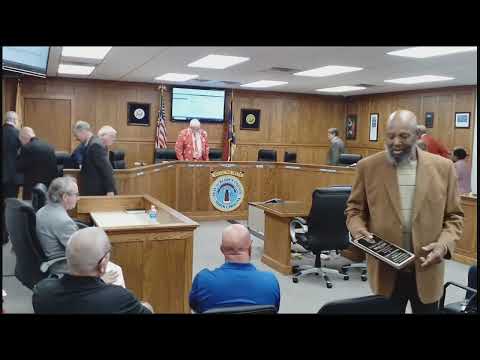
Carl Manning, director of Kingdom Community Development, told the Bladen County Board of Commissioners on Dec. 16 that his nonprofit could develop a 16-unit single-family subdivision intended for affordable and workforce homeownership, and asked the county to consider contributing $1 million toward the project.
Manning said the plan would use multiple funding sources — including the U.S. Department of Agriculture, the state Housing Finance Agency programs (CPLP and Home Advantage), HUD-related home funds, the Rural Center and other partner grants — to lower costs for buyers who earn at or below 80% of area median income. He described a capital stack that, in his estimate, would leverage roughly $1,000,000 in local investment into about $4,000,000 in total project value once other funding and infrastructure were included.
The proposal drew detailed questions from commissioners about the math and risk. Manning presented line items he said were preliminary: a land estimate of about $195,000, development/infrastructure roughly $1.1 million, estimated vertical construction in the millions, administrative and consultant fees, and a total project figure he described as “right around” the multi‑million-dollar range. Manning also outlined potential down-payment assistance amounts available to individual buyers through CPLP (he said the assistance could range up to $50,000 in some scenarios) and an additional $15,000 from Home Advantage.
A spreadsheet shown during the presentation initially indicated a county “breakeven” period of 47 months based on property-tax projections. Commissioners and staff then recalculated and said the figure as presented equated to about 47 years. Commissioners emphasized that discrepancy as emblematic of why they would not commit public funds without detailed, written backup.
Chairman Peterson and other commissioners asked Manning to return with a written summary that includes clear capital-stack scenarios, the effect of including USDA and other partner funding, alternate scenarios showing faster county payback (for example where the county supplies land or buys a larger site), and a full list of assumed costs and sources. No formal county commitment or vote was taken; commissioners said they would not approve a large investment without contracts and more documentation.
Manning said Kingdom CDC has done similar single-family ownership projects in Cumberland County (Spring Lake and Fayetteville), and that proceeds from sold homes are typically reused for additional projects under nonprofit home-fund rules. He said the project remains preliminary and would require coordination with local town planning, water and sewer authorities and partner agencies.
Commissioners also raised the larger local policy context: several members noted a decline in county population and said lack of available housing affects school enrollment and workforce recruitment. Commissioners signaled interest in affordable and workforce housing but stressed the need to see written scenarios that demonstrate how county dollars would be leveraged and what the county’s financial exposure would be.
Manning said he had $150,000 in USDA funds he could apply again, and that the project scale — larger than 16 units — would improve economics. Commissioners asked him to include alternative scales and funding mixes in the follow-up paperwork and to provide clear written commitments or memoranda from partner agencies where applicable.
The discussion ended with no vote. Manning said he would return with the requested documentation and additional funding details for the board to review.