Get Full Government Meeting Transcripts, Videos, & Alerts Forever!
Get email alerts on the Infrastructure Use Fee topic
No spam. Unsubscribe anytime.
Committee forwards enterprise payment impact study on street wear to council
Summary
The committee voted 3-0 to forward an Annual Enterprise Payment Impact Cost Reimbursement Study (IUF methodology) to the City Council as a receive-and-file item; staff and consultants described a conservative, data-driven methodology focused on solid waste truck impacts and peer review support.
The Oxnard Public Works and Transportation Committee voted to forward the city’s annual enterprise payment impact cost reimbursement study to the City Council as a receive-and-file item. The study provides a methodology for calculating infrastructure-use-fee (IUF) transfers from enterprise funds — in this discussion, primarily the solid waste fund — to cover the proportional street-repair costs associated with those enterprises.
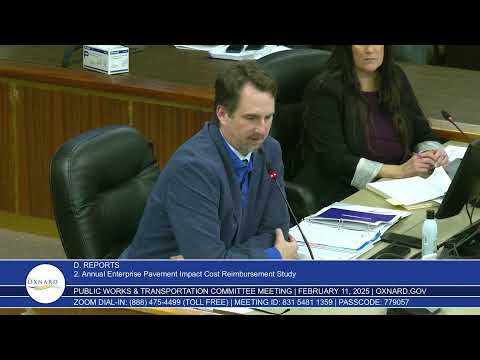
The study focuses on measurable, city-specific factors such as the actual weights of city trucks, truck routes and the percentage of residential streets and alleys the trucks traverse. A consultant, identified in the meeting as Eric, described the approach as conservative and data-driven: the analysis estimates how much of a street’s design life is consumed by enterprise vehicles and multiplies that percentage by street rehabilitation budgets to determine the transfer amount.
Michael Wolfe and staff outlined the background: a 2014 report proposing infrastructure transfers was litigated and the city was required to produce a justified methodology for any transfer under California law. Staff retained outside consultants and limited the current report to pavement impacts (omitting earlier public-safety and administrative components). The study includes a peer review memo; staff summarized the peer reviewer’s conclusion as finding Bartle and Wells’ methodology reasonable and conservative.
Committee members questioned methodology, compliance with Proposition 218 (local fee requirements), and how the charge would be phased. Staff said the IUF calculation is intended to reflect actual cost and that the proposed solid-waste transfer was designed to meet constitutional requirements. Staff also said the proposed solid-waste IUF would be phased in (half in the first year, then full in 2025–26); water and wastewater rates were not changed as part of this action.
Committee members moved to forward the study to the City Council for receipt and filing; the motion carried 3-0 (Committee member Teran yes, Committee member Basula yes, Chair McArthur yes). No members of the public registered to speak on the item.