Get Full Government Meeting Transcripts, Videos, & Alerts Forever!
Get email alerts on the Bylaws topic
No spam. Unsubscribe anytime.
OHA trustees debate bylaws revisions including chief of staff role and public testimony time
Summary
The Office of Hawaiian Affairs Board of Trustees held a first reading of proposed bylaws that would expand the chief of staff's role, add a second vice chair, and change testimony and presentation time limits, touching off debate over whether the draft would allow the chief of staff to manage trustee aides and secretaries.
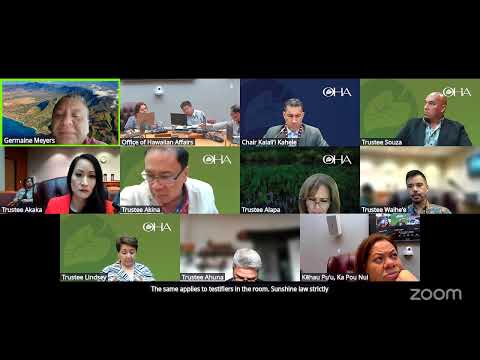
The Office of Hawaiian Affairs Board of Trustees held a lengthy first reading and discussion of proposed revisions to its bylaws (action item BOT 2501), focusing on the role of a chief of staff, who the draft says would "coordinate daily trustee aide and secretary staff functions, operations and activities," changes to testimony and presentation time limits, and creation of two vice chair positions. Interim General Counsel Everett Ota walked the board through the draft and said the package also removes provisions that conflict with Hawaii's Sunshine Law and updates references to state ethics statutes.
Why it matters: The proposed wording prompted trustees to question whether the chief of staff language would effectively let that position direct or manage staff who currently serve at the pleasure of individual trustees. Trustees said that change could create conflicts of loyalty for trustee aides and secretaries and undermine trustee independence. The board did not adopt the bylaws at this meeting; trustees asked counsel to revise the language and return a new draft for consideration at the Feb. 6, 2025 meeting.
The packet presented to trustees included a clean draft of revised bylaws, a redline comparing the proposed draft to bylaws adopted in October 2024, and the existing bylaws. Everett Ota, identified in the meeting as interim general counsel, summarized proposed changes including adding a second vice chair position, clarifying committee succession, making explicit a chairperson-emeritus designation, and tightening requirements to ensure written testimony rules comply with Sunshine Law.
Public testimony at the meeting included a speaker who urged caution on shortening public testimony. Doreen Myers, who identified herself as an OHA beneficiary and a homestead lessee, said she was concerned about a proposal to limit testimony to three minutes and pointed trustees to Department of Hawaiian Home Lands administrative rules (10-2-11 and 10-2-12) that provide for longer presentation time in that agency. "For beneficiaries to feel heard, I ask that OHA adopt bylaws to mirror DHHL's Administrative Law 10-2-11 and 10-2-12 if you're going to be reducing it to 3 minutes," Myers said during her remarks.
Trustees across the dais raised specific concerns about Article 14(a) in the draft, which states in part that the chief of staff "shall manage all operations and staff of the board chairperson's Oahu and Island offices" and would be responsible for coordinating trustee aide and secretary activities. Trustee Ahuna said the clause could be construed to grant the chief of staff daily management authority over trustee aides, who trustees hire and supervise, and said, "I disagree with this proposed bylaw...our trustee aids are hired and managed by us trustees and not anyone else." Trustee Akaka and others urged removal or narrowing of the words "coordinating daily trustee aide and secretary staff functions, operations, and activities," saying that "coordinate" as drafted felt like it could become management.
Chair Kahele and other trustees described a middle ground: they said the chief of staff should be a conduit to help trustees get timely responses from administration while not micromanaging individual trustee offices. Chair Kahele said he views the chief of staff "as an extension of the chair's office" who should help the nine trustee offices work together, but he repeatedly said the aides "serve at your pleasure" and affirmed that trustees should retain supervision of their own aides and secretaries. Everett Ota acknowledged the existing bylaws already used the word "coordinate" for board staff functions and said the proposed draft tightened that language, but he and trustees agreed revision and clarification were warranted.
On testimony and presentations, the draft would limit agendized presentations to 15 minutes and testimony to three minutes, subject to extension by the chair or majority vote. Several trustees and public commenters pushed back on a three-minute limit for public testimony. Trustees discussed an operational approach used by some chairs: provide a visible timer and a 30-second warning so speakers can wrap up, and allow more time when a small number of presenters or neighbor-island testimony arrives in person. The board left the specific time limits for staff to revise with counsel; Chair Kahele said he was open to keeping the current practice or adjusting the limits after feedback.
Other changes summarized by counsel include explicit succession language for chair and committee leadership, a new vice chair role focused on trustee training and orientation, a second vice chair role focused on timely posting and adoption of meeting minutes (the draft references a statutory requirement to post draft minutes within 40 days), and clarifications to ethics-training references to align with HRS chapter 84.
Outcome and next steps: Trustees did not vote to adopt the draft bylaws at this meeting. Instead the board asked counsel to incorporate the feedback, especially narrowing or removing the "daily coordinating" language regarding trustee aides and clarifying that the chief of staff role is not intended to supplant trustee supervision of their own staff. The chair said the revised draft would be agendized for further discussion and possible action at the Feb. 6, 2025 meeting. Action item BOT 2502 was deferred to a later date.
The board did record a roll-call vote to adjourn the meeting; the clerk counted eight yes votes and the meeting was adjourned.
The board discussed seeking legal and executive-session review of several open questions, including whether the creation of two vice chair positions and the chair's designation of a successor is consistent with statutory certification language the board currently sends to the lieutenant governor's office. Counsel and trustees agreed to schedule executive-session review on legal alignment with Hawaii Revised Statutes and the agency's executive policy manual before any final bylaws vote.
The trustees asked staff and counsel to return a revised bylaws draft that removes ambiguous managerial language about trustee aides, clarifies lines of communication between trustee staff and administration, and ensures Sunshine Law compliance; that draft will be discussed at the Feb. 6 meeting.