Get Full Government Meeting Transcripts, Videos, & Alerts Forever!
Get email alerts on the Residential Safety Spa Variance topic
No spam. Unsubscribe anytime.
Board upholds planning director's denial of swimming-pool permit; therapeutic spa variance denied
Summary
St. Tammany Parish Board of Adjustments declined to overturn the planning director's denial of a building permit for a backyard therapeutic spa that lacked a four-foot perimeter fence; motions to overturn and to reconsider failed for lack of the required votes.
The St. Tammany Parish Board of Adjustments on Dec. 3 declined to overturn a planning director's denial of a building permit for a backyard therapeutic spa, concluding members were not prepared to approve a permanent exception to the parish's four-foot pool-fence requirement.
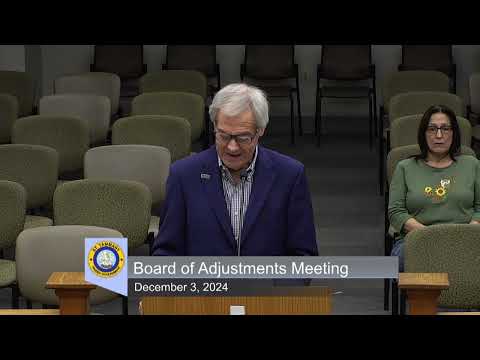
The board heard an appeal by petitioners represented by attorney Jeff Shane of Jones Fussell Law Firm, who said the homeowners planned a therapeutic spa attached to an existing rear porch and would secure the unit with a locked, hard cover. The Planning Department denied the permit because the site plan did not show the required permanent fence or self-closing, self-latching gates as required by UDC Section 400-8nn, staff said.
Shane told the board the structure is a therapeutic spa used for medical reasons, not a traditional swimming pool with apron and deck. He said the spa would be 13 by 18 feet, flush with the rear porch, and that the applicants would use a hard cover rated to hold roughly 300 pounds. Shane also gave the board copies of no-objection letters from the homeowners association and adjoining property owners and submitted photographs and a manufacturer's sample of the cover.
Mimi Dawson, identified in the record as representing the Money Hill developer and the architectural control committee, told the board the committee reviewed the plan and did not view the spa as the same type of structure the fence rule was intended to regulate. John Chapetta, a local property-and-casualty agent, told the board as a field underwriter he believed a rigid, lockable cover combined with dense landscaping would be at least as protective as some removable fences and offered that he would support underwriting the property under those conditions.
Board members pressed on safety and human-error concerns. Board member Frank Swindell and others repeatedly raised the risk that a homeowner might inadvertently leave a spa uncovered or unattended and that the cover would not prevent an unsupervised child from reaching the water if they circumvented the porch access. Several members said the parish's fence requirement was specifically adopted to reduce drownings and that the director had little discretion to ignore the rule without clear legal basis.
The board considered multiple motions. A motion to overturn the planning director's denial failed on a 2-3 vote. Board counsel and staff advised that overturning the director's decision would require four votes. After additional debate, members considered a motion for reconsideration and a conditional motion that would have overturned the denial only if the applicants submitted and obtained staff approval of a landscaping plan to create a dense perimeter barrier prior to final inspection. That motion received a 3-2 vote but failed because four affirmative votes were required to overturn the director's decision. As a result the director's denial remained in place.
The board did not adopt any modification to the UDC or issue a conditional variance. The applicant was told the door remained open to return with alternate plans, but no permit was issued at the meeting.
Board members who spoke on the record included Frank Swindell (expressed safety concerns), board member (last name) Daley (emphasized the symbolic and physical function of a fence), and others who split on whether the locked cover and landscaping constituted a reasonable alternative to a fence.