Get Full Government Meeting Transcripts, Videos, & Alerts Forever!
Get email alerts on the Higher Education Finance topic
No spam. Unsubscribe anytime.
Consultants recommend major governance, funding and staffing changes for Connecticut State Colleges and Universities
Summary
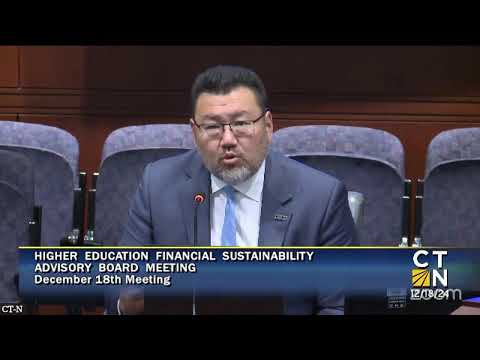
The National Center for Higher Education Management Systems presented a data-driven review of the Connecticut State Colleges and Universities to the Higher Education Financial Sustainability Advisory Board, urging immediate strategic and structural changes to address long-term enrollment declines and fiscal pressure.
The National Center for Higher Education Management Systems presented a data-driven review of the Connecticut State Colleges and Universities to the Higher Education Financial Sustainability Advisory Board, urging immediate strategic and structural changes to address long-term enrollment declines and fiscal pressure.
The consultant said the study, funded through ARPA dollars allocated to the Office of Policy and Management, was intended “to conduct an independent third party study of the Connecticut State Colleges and Universities.” The report examined enrollment, staffing, facilities and governance and offered short- and long-term options for the system and the state to consider.
Why it matters: the consultant concluded that continuing demographic declines in traditional-college-age students, falling college-going rates and strong out-of-state competition mean the current scale and organization of CSCU are not sustainable without major change. The report recommends clarifying system vs. institution roles, aligning staffing with enrollment, pausing new building plans until space inventories and priorities are clear, and creating a stronger statewide coordinating function for postsecondary policy and funding.
Consultant findings and recommendations - Enrollment and demographics: The report notes national and state trends of declining traditional-age students and lower college-going rates. It cites the Western Interstate Commission for Higher Education projections showing Connecticut’s projected decline from 2023–2030 is smaller than earlier estimates (about a 4% decline vs. a national 10% decline), but still downward overall. The consultant said these demographic pressures will continue to constrain demand for the system’s current footprint.
- Funding and costs: The consultant highlighted that Connecticut ranks near the top nationally in combined state appropriations and tuition per student, and that personnel costs (about 70–80% of budgets) are the primary driver of institutional costs. The presentation warned that staffing and expenses have not fallen as fast as enrollment, increasing employees-per-student ratios in ways that harm long-term financial sustainability.
- System governance and roles: The report recommended clearer delineation between system-office functions and institution responsibilities so the system “adds value to the functioning of institutions,” rather than acting solely as an approving authority. Options included keeping the current system with stronger accountability, eliminating the system and leaving separate institutions, designating one institution to carry out system functions, or creating a more formal statewide coordinating agency to set policy and align investments.
- Western Connecticut State University: The consultant identified Western as a high priority, noting it has struggled with reserves and fiscal health since the mid-2010s and urging the system office to make resolution of Western’s issues its “highest priority.”
- Charter Oak and shared services: The report flagged Charter Oak’s different business model and suggested it could be leveraged for innovation. It also proposed exploring a separate shared-services organization governed by presidents or designees to create quasi-market incentives for efficient back-office functions while preserving student-facing services.
- Space and capital: The consultant and a separate space-management study both found that the system likely has more space than needed and lacks sufficiently detailed, prioritized facility plans. The recommendation includes a moratorium on adding new net square footage until inventories, prioritization rubrics and alignment with strategic goals are complete.
- State-level policy actions: Among recommendations for the state were forming a statewide coordinating board or agency (or expanding OHE’s mission), updating the higher-education funding model to align incentives with state workforce goals, conducting a policy audit (including financial aid suitability for adult learners), and adopting a statewide dual-enrollment policy.
Quotes and exchange Secretary Beckham, who introduced the consultants, described the funding and intent for the work: “As part of the 24, 25 biennial budget, we were allocated OPM was allocated some ARPA funds to hire a consulting firm with higher education expertise … to conduct an independent third party study of the Connecticut State Colleges and Universities.”
Consultant Brian Prescott summarized the system-office priority: “We think that in order for that to play out, the system office really needs to prioritize how it adds value to the functioning of institutions.”
Chancellor Chang emphasized the long-term returns to degrees in the Q&A: “Those who earn an associate’s degree will ultimately earn $750,000 more across approximately a 30 year career. A bachelor’s degree, you will earn approximately $1,100,000 more during your career. And with a master’s degree, you will earn approximately $1,400,000 more in your career.”
Questions from board members Board members pressed the consultants on causes and remedies. Topics in the Q&A included whether rising net costs reduce enrollment (the consultant said cost and perceived value both matter), how branch campuses and UConn regional campuses affect CSCU enrollment, how to parse instructional vs. non-instructional staffing needs, and whether a new coordinating agency would duplicate OHE’s work.
Board next steps and public process Both the secretary and consultant emphasized that recommendations are for consideration and that public comment and legislative hearings will follow. The advisory board said it plans to invite the consultant back to answer follow-up questions at the next meeting, scheduled for Jan. 6, and to continue stakeholder engagement before any policy decisions are made.
Ending The report frames a series of governance and funding choices for policymakers: keep the existing system with stronger accountability, reorganize system functions, or create a new coordinating entity to align postsecondary funding and policy. The consultant and CSCU leaders urged coordinated follow-up, targeted work on Western’s finances and careful phasing of any major structural change so that students and regional access are not disrupted.