Get Full Government Meeting Transcripts, Videos, & Alerts Forever!
Get email alerts on the Wildfire Management topic
No spam. Unsubscribe anytime.
Residents, scientists urge Austin to rethink park land management, warn against broad tree clearing and widespread prescribed burns
Summary
City council public comment on land-management and wildfire planning featured multiple scientists and conservation groups urging caution with large-scale tree clearing and prescribed burns, citing local ecology, water recharge, air quality and karst cave impacts.
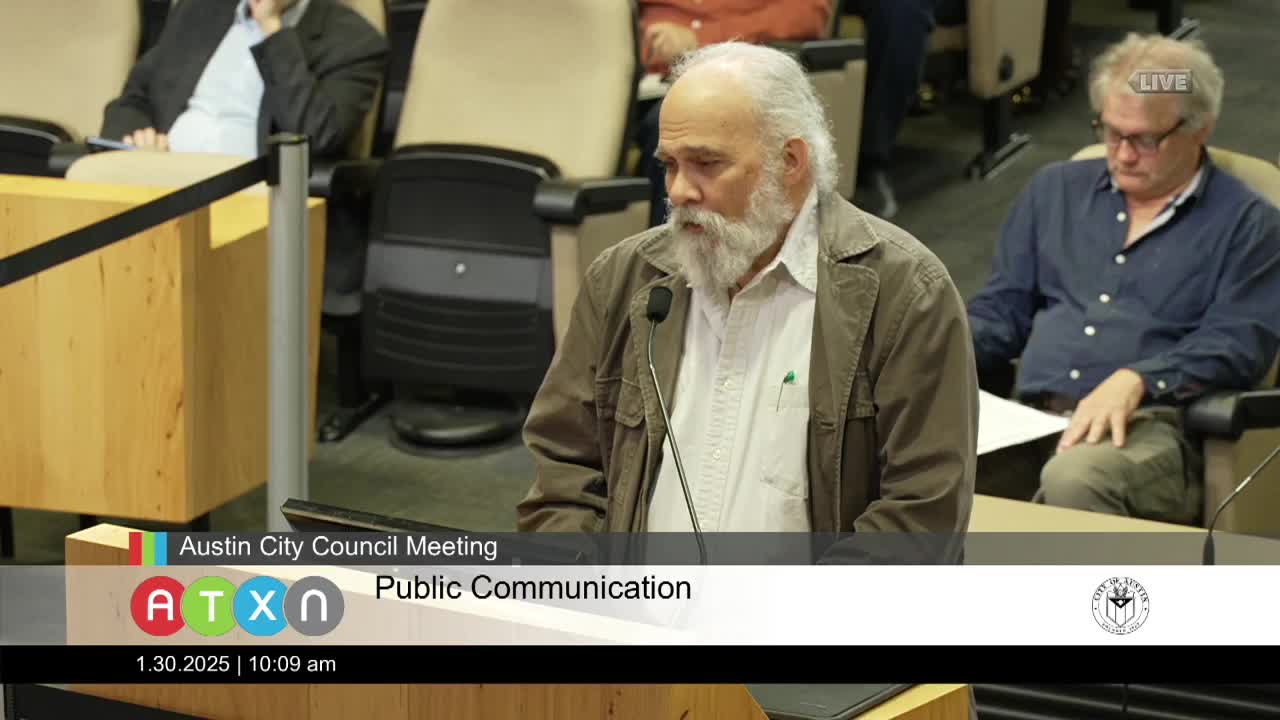
Dozens of residents, environmental scientists and conservation groups urged the Austin City Council on Jan. 30 to slow and rethink city plans for tree clearing and prescribed burning on publicly managed lands, arguing the proposed approaches risk degrading water recharge, air and soil quality and habitat in the Edwards Plateau and Balcones Canyonlands region.
Scientists and longtime land stewards told council members that management approaches developed for western conifer forests do not translate to central Texas limestone landscapes, and that proposals to substantially thin canopies and increase prescribed burns across thousands of acres would likely increase — not decrease — wildfire risk in many local conditions.
The calls came during public comment on consent items related to parkland and Austin Water land-management plans and funding. Elizabeth McGreevey, a natural-resources consultant and program director of the nonprofit Project Bedrock, said Baylor University's 2009 Austin-Travis County Community Wildfire Protection Plan and more recent regional studies better reflect the ecological conditions of the Edwards Plateau than West Coast research. "Why would we pay a team from Oregon to do a wildfire assessment for our limestone, flash-flood-prone region?" McGreevey asked. "Use scientists here who have studied this landscape."
Nico Howard, a scientist who has worked on recharge protection at Barton Springs, said multiple Austin land-management plans in recent years call for clearing and burning thousands of acres. He warned that clearing can dry soils, increase wind speeds through opened canopies and allow grass encroachment that supports faster, hotter ground fires. "Clearing and burning can decrease recharge, increase downstream flooding and worsen air quality," Howard said.
Other speakers, including Bill (William) Bunch of Save Our Springs Alliance and Roy Whaley of the Sierra Club, echoed those concerns. Bunch warned that large-scale projects proposed and budgeted without full public engagement could harm springs and water supplies and said the city should prioritize soil and forest preservation and home hardening instead of broad clearing. Whaley said many recent regional fires have resulted from structures burning in urban areas rather than forest fuels, and that human ignition sources remain a key risk factor.
Several commenters noted the presence of karst features and caves on some managed preserves, including William Russell Preserve, and said thinning and burning could cause erosion that fills caves and damages bat habitat. Howard said some preserves currently have canopy cover above 80'—and that planned thinning to 20'— would dramatically change those sites.
Park staff and proponents have argued that targeted thinning, vegetation management and prescribed fire are tools to reduce hazardous fuels in high-risk areas and to restore ecological conditions in some management units. Supporters say careful plans with monitoring and site-specific science can reduce potential harms.
The council did not take a vote on management policy during the public-comment period. Several speakers asked council to postpone major contracting decisions and to ensure the city uses locally relevant science and independent conservation assessments, monitors air and water impacts of burns, and limits large-scale actions until those analyses are complete.
Council members and staff acknowledged the concerns raised during the comments and said they would carry them into upcoming budget deliberations and to the departments preparing land-management and wildfire planning. Staff did not announce any immediate contract awards or changes on the dais.
Why it matters: Austin manages tens of thousands of acres of public land that feed springs and reservoirs for the city's drinking water, and the competing priorities of wildfire risk reduction, habitat protection and water recharge intersect on those landscapes. Because prescribed burning releases particulate matter and mercury and clearing alters infiltration and erosion patterns, residents told council the city must base management on regionally appropriate science and monitor public-health effects before scaling operations.
What to watch next: Multiple speakers asked council to require independent conservator assessments, to prioritize protection of karst caves and springs, and to ensure any contractor selection includes local specialists with detailed experience in Central Texas ecosystems. Council members said they expected continued discussion during budget and committee work this year.