Get Full Government Meeting Transcripts, Videos, & Alerts Forever!
Get email alerts on the Prepackaging topic
No spam. Unsubscribe anytime.
Patients and growers warn prepackaging rule will harm medicine quality, small businesses
Summary
Commenters at OMMA's Dec. 17 public-comment meeting said implementation of House Bill 3361 and related permanent rules requiring prepackaging of flower would risk mold, reduce patients' ability to inspect medicine, and squeeze small growers and dispensaries.
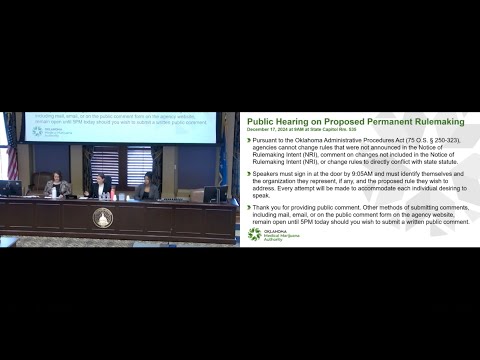
During the Oklahoma Medical Marijuana Authority's Dec. 17 public-comment meeting, patients, growers and dispensary operators urged the agency to reconsider implementation details for prepackaging required by House Bill 3361.
"Our patients who come to us are already sick, especially our cancer patients. I can't consciously sell them something that I know can make them more sick," said Tracy Turner, who identified herself as a patient and who spoke on behalf of her family's dispensary, Groovy Cats.
Turner and others described concerns that prepackaging flower would prevent dispensary staff and patients from assessing aroma, moisture and visible defects. She told the authority that improper drying, curing or sealed packaging can "cause mildew and possibly mold," and said limited sample jars and on-shelf samples will not substitute for the ability to inspect product closely.
Growers and processors also raised business and operational questions. Brie Truitt of Luxe Cannabis asked that packaged flower be allowed to return to the original licensee for reprocessing rather than being automatically treated as waste. "The original licensee should be the one to determine if a return is waste or usable or can be processed further into a new product," Truitt said, noting shipping, storage and relabeling complications.
Speakers sought clarity on labeling and testing questions tied to final-form COAs. Steven Blackburn asked whether each package size would require separate final-form testing and COAs. Justin Wood, a processor with extraction experience, asked OMMA to provide definitions for "live resin," "cured resin" and "distillate" so packaging labels and QR-code COAs can be consistent.
Several speakers objected to the pace and cumulative effect of regulatory changes. Summer Whiteman said the industry has experienced "an avalanche of disturbing and inefficient changes" since prior rulemaking and urged greater transparency and support for legacy operators.
Industry representatives also raised potential conflict-of-interest concerns tied to legislative sponsors of prepackaging legislation and asked OMMA to promote transparency about which companies legislators may have affiliations with so that the industry can engage earlier in policymaking.
OMMA staff reminded attendees that comments will remain open online until 5 p.m. local time on the day of the meeting and that written responses will be provided to every commenter.
Ending: Stakeholders asked OMMA to publish clarifications about returns, labeling, COA expectations for prepackaged product and to provide a transition period that recognizes the training and equipment needs of small growers and processors.