Get Full Government Meeting Transcripts, Videos, & Alerts Forever!
Get email alerts on the Laboratory Testing topic
No spam. Unsubscribe anytime.
Stakeholders tell OMMA pesticide expansion outpaces lab capacity; urge enforcement first
Summary
During OMMA's Dec. 17 public-comment meeting, laboratory directors, growers and patients warned that a proposed expansion of the pesticide analyte list and lower action limits would exceed many Oklahoma labs' technical abilities and urged the agency to enforce existing rules and delay new requirements until the state QA lab is operational.
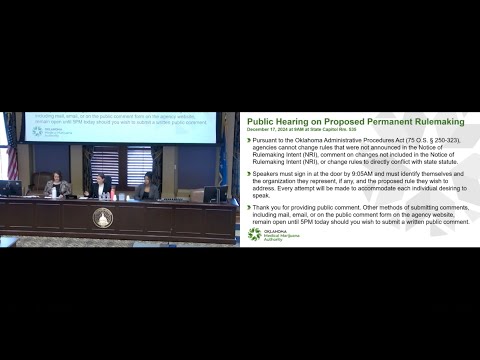
At a public comment session of the Oklahoma Medical Marijuana Authority on Dec. 17, 2024, laboratory directors, growers and patient advocates told agency staff that a proposed expansion of the pesticide analyte list from 13 to 60 and sharply lower action limits would exceed the technical capacity of many state testing laboratories.
"Expanding the pesticide list without first addressing these critical enforcement gaps does not enhance safety. It merely widens the scope of failure," said Matthew Phillips, CEO of Oklahoma Compliance Testing Lab.
Speakers repeatedly urged OMMA to prioritize enforcement of existing laboratory requirements before adding new analytes or requiring new instrumentation. Jeremy Woods of Wild West Compliance told the authority that some laboratories are not following current quality-control rules and that equipment upgrades could cost hundreds of thousands of dollars. "Labs are gonna have to spend $400,000 to change equipment out," Woods said.
Several laboratory representatives and technicians explained technical limits tied to instrument types and quality-control procedures. Cole Allman, medical director at Oklahoma Compliance Testing Laboratory, pointed to a statutory expectation that the agency provide standard operating procedures and an equipment list, referencing a state statutory citation discussed at the meeting. Ryan Crist, lab director at High Bridal Labs, said the proposed action limits are "about 20 parts per 1,000,000,000," a concentration he described as effectively at the bottom limit of reliable quantification in the cannabis matrix.
Speakers argued the rule language limiting allowable instrumentation to LC triple quadrupole mass spectrometers was too narrow for the proposed analyte list. "For some of these compounds, the ability to use a GC triple quad is absolutely necessary," Crist said. Laboratory speakers, including Brandon Mosley and Dalton Hilburn of Havard Industries, urged OMMA to allow multiple validated instrument platforms and to publish the QA lab's standard operating procedures, recommended columns and solvents before enforcing new analytes.
Multiple witnesses recommended delaying enforcement until the state QA laboratory is fully functional and can demonstrate methods and proficiency. Brandon Mosley said stakeholders had been told the QA lab would be functional by February and urged OMMA to "table the proposed pesticide list until the state lab is functional and they can demonstrate that these 60 pesticides can truly be determined."
Commenters also raised quality-control implementation concerns. Several speakers described proficiency-testing failures across the state and argued that existing enforcement is inconsistent: "Rules are only for those who choose to follow them," Phillips said, saying noncompliant operators undermine the system and harm compliant labs and patients.
OMA staff did not announce formal actions at the meeting. Commenters asked for clearer guidance from OMMA on instrumentation, limits, QC sample composition and an explicit timeline tied to the QA lab's demonstrated capabilities.
The meeting record contains multiple technical requests and warnings from the laboratory community that the proposed rule as drafted would create false negatives and require equipment and QC changes that many labs cannot meet without significant time and expense. Several speakers urged OMMA to publish recommended SOPs and an instrument/equipment list and to coordinate an implementation schedule that reflects laboratory capacity and accreditation needs.
Ending: If OMMA modifies the pesticide rule language or publishes SOPs, stakeholders asked the agency to notify the public and provide a transition period tied to the QA lab's demonstrated testing capabilities. Comment deadlines and written responses were noted by agency staff at the end of the meeting.