Get Full Government Meeting Transcripts, Videos, & Alerts Forever!
Get email alerts on the Missing Persons Reporting topic
No spam. Unsubscribe anytime.
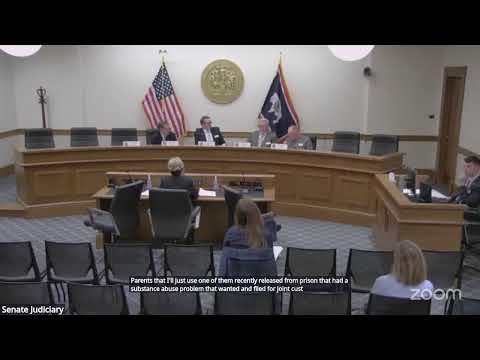
Committee advances Senate file 114 to require consistent missing-person reporting; advocates cite statewide gaps
Summary
Senate file 114 to create a standardized process for reporting and accepting missing-adult reports passed the Judiciary Committee after testimony from law enforcement, victim advocates, researchers and family members citing inconsistent reporting practices across agencies.
The Senate Judiciary Committee voted to advance Senate file 114, a bill to establish a consistent process for law enforcement to accept and prioritize adult missing-person reports in Wyoming. Testimony described a patchwork of current practices that rely on voluntary reporting to the state's clearinghouse and sometimes lead to delays in entering cases into federal systems such as the National Crime Information Center (NCIC).
Senator Landon, sponsor of SF 114, told the committee Wyoming requires the Division of Criminal Investigation (DCI) to collect missing-person data but “there's no requirement for law enforcement to accept reports of missing persons.” He said the bill “outlines a specific procedure for all Wyoming law enforcement agencies to follow when accepting these reports” and seeks to reduce duplication and delays when agencies point callers between jurisdictions.
Alan Thompson, executive director of the Wyoming Chiefs and Sheriffs Association, said the bill offers a “straightforward playbook” for primary jurisdiction and investigation steps. Thompson described drafting language based on other states’ laws and told senators the measure “contemplates any of the issues that we face” and helps both law enforcement and private-sector partners who compile missing-person notices.
Witnesses emphasized the bill’s importance for underserved communities. Cara Chambers, Director of the Division of Victim Services in the Attorney General’s office, warned committee members that enumerated exceptions should be “narrowly tailored” so agencies do not have reasons to refuse reports. Dr. Emily Grant, a senior research scientist at the Wyoming Survey and Analysis Center (WYSAC), summarized a commissioned study finding 40 states and D.C. require entry of adult missing-person cases into NCIC; she said Wyoming has no legislative requirement and relies on voluntary submissions.
Family members and advocates gave personal testimony. Desiree Tinoco, founder of the Missing People of Wyoming nonprofit, described getting reports denied entry “due to the individual's lifestyle, income, criminal history, questionable background, or not having a physical address.” Nicole Wagon, an MMIP (Missing and Murdered Indigenous People) advocate and Fremont County resident who lost a daughter in 2019, said inconsistent responses are “terrifying” for families and stressed the first hours and days after someone disappears are “the most critical.” Chad Auer, senior policy advisor to the governor, expressed executive-branch support and noted the governor prioritizes public safety and the Missing and Murdered Indigenous Persons Task Force work.
Committee amendments clarified language on which cases may be refused. Senators modified an internal phrasing so the bill reads that a person’s most recent verifiable location—not residency—controls whether Wyoming should be the reporting jurisdiction. The committee also replaced an “and” with an “or” in the listed exception language and added a drafting change to include “including but not limited to” before enumerated bad-faith reporting reasons, to avoid unduly limiting exceptions. After amendment adoption, the committee approved SF 114 on a roll call of 4 ayes, 1 excused.
Ending note: The bill moves out of committee with sponsor and stakeholder support and specific amendments intended to keep refusal reasons narrowly tailored while ensuring broad opportunity for reports to be accepted and entered into NCIC and other systems.