Get Full Government Meeting Transcripts, Videos, & Alerts Forever!
Get email alerts on the Post Conviction Dna Testing topic
No spam. Unsubscribe anytime.
Senate file 101 would narrow cutoff date for post-conviction DNA testing eligibility
Summary
A bill to change a statutory cutoff date for post-conviction DNA testing in Wyoming was introduced and discussed in the Senate Judiciary Committee. Sponsors and witnesses argued the change would correct an unintended gap in the law; the committee left an initial vote open for absent members.
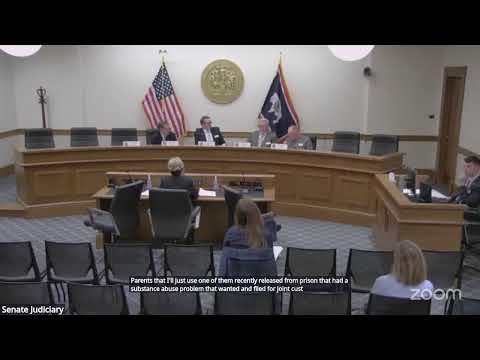
Senate Judiciary Committee Chairman Olsen heard testimony on Senate file 101, a bill from Senator Landon that would change the statutory cutoff date limiting court-ordered post-conviction DNA testing. Senator Landon introduced the measure and explained the bill would move the critical cutoff from the year 2000 to 2008 to align with the year Wyoming enacted its post-conviction DNA statute.
The bill’s sponsor, Senator Landon, said the statutory language in WS 712303 creates “an unintended consequence” because the 2000 cutoff prevents people convicted before 2008 from relying on a statutory decision that did not exist when they were convicted. He told the committee the proposal “would move that date up to 2008 at the time that Wyoming passed this post conviction DNA law.”
Emily Madden, an attorney who identified herself as a University of Wyoming College of Law graduate and board member of the Wyoming Criminal Defense Lawyers Association, testified in support. Madden said: “all things considered, the cost of DNA testing is relatively inexpensive, especially when you consider the financial costs that we have when you're talking about imprisoning persons for decades and sometimes, life in prison.” She described a client, Eddie Magallanes, convicted in 2006, who she said learned of DNA evidence only at trial and who she said has private funding available for testing.
Lauren McLean, a University of Wyoming law professor who previously worked with innocence and DNA litigation, gave technical background on DNA technology and timelines. McLean summarized changes in testing methods and databases, noting that “by the year 2008, we are starting to look at an increased technology that's capable of picking up very small samples, capable of reading degraded samples, and capable, we're more capable of distinguishing between profiles.” She told the committee that technology and database availability improved substantially during the 1990s and into the 2000s, and that the 2008 date better matches when modern testing and comparison systems were broadly available.
Committee members asked about fiscal impact. Senator Kolb moved the bill and the committee took a roll call; three members present voted aye with two members excused. Chairman Olsen left the vote open to allow absent members to return and complete the roll call.
No final committee action was recorded during the hearing. The sponsor said he would follow up with fiscal details and that private funding is available in at least one pending case.
Ending note: Committee staff will carry forward fiscal follow-up and the bill remains pending while absent members have the opportunity to record their votes.